AML Compliance


Last Updated: March 2026
Based On Regulatory Guidance, Industry Data And Market Analysis
Anti Money Laundering compliance continues to evolve rapidly as financial institutions face increasing regulatory pressure, rising operational costs, and more complex financial crime risks. In 2026, compliance is no longer just a regulatory requirement. It has become a core operational function that directly impacts efficiency, scalability, and competitive positioning.
Global regulatory expectations continue to emphasise a risk based approach, requiring institutions to demonstrate both effectiveness and proportionality in their compliance frameworks. Guidance from the Financial Action Task Force recommendations reinforces the need for systems that can detect genuine risk without overwhelming teams with unnecessary alerts.
At the same time, institutions are dealing with growing volumes of transactions, real time payment expectations, and increasingly sophisticated financial crime typologies. These pressures are exposing the limitations of legacy compliance systems and driving the need for more advanced approaches.
This report provides a comprehensive view of AML compliance in 2026, combining regulatory insights, operational data, and industry trends to highlight the challenges and opportunities facing financial institutions.
AML compliance is no longer constrained by detection capability. It is constrained by efficiency.
The AML Efficiency Gap
In 2026, many institutions face what can be described as the AML Efficiency Gap, the gap between compliance activity and actual risk reduction.
Despite increasing investment in systems and staffing, a large proportion of effort is spent on alerts and processes that do not lead to meaningful outcomes. This creates a structural inefficiency where more activity does not necessarily translate into better detection.
The challenge in modern compliance is not identifying risk, but prioritising it correctly.
Key AML Compliance Statistics In 2026
Understanding the current state of AML compliance requires examining key industry benchmarks and operational metrics. While figures vary by institution and jurisdiction, several consistent patterns emerge across global financial systems.
Industry Benchmarks
Understanding the current state of AML compliance requires examining key industry benchmarks and operational metrics. While figures vary by institution and jurisdiction, these ranges are consistently reflected in regulatory commentary and industry research, including guidance from the Financial Action Task Force and supervisory observations from the Financial Conduct Authority.
Together, these benchmarks provide a reliable view of how compliance systems are performing across global financial institutions.
Metric | Estimated Range | Context |
|---|---|---|
Global AML Compliance Costs | $200B+ annually | Industry and regulatory estimates |
False Positive Rate | 85% – 95% | Screening and monitoring systems |
Alerts Converted To SARs | 1% – 5% | Regulatory reporting benchmarks |
Average Investigation Time | 20 – 60 minutes | Operational estimates |
Daily Alerts (Large Institutions) | 10,000+ | High volume transaction environments |
These benchmarks are widely referenced across regulatory guidance, industry studies, and internal operational reporting within financial institutions, reinforcing the consistency of these patterns across different jurisdictions and compliance frameworks.
Regulatory oversight from the Financial Conduct Authority financial crime guidance continues to highlight inefficiencies in compliance systems, particularly in relation to alert volumes and operational effectiveness.
For deeper analysis of alert inefficiency, see AML false positive rates and false positive statistics.
What This Data Indicates
The statistics above are not isolated figures. They reflect deeper structural issues within AML systems, particularly around efficiency, scalability, and prioritisation.
What These Numbers Reveal About AML Systems
These figures indicate that many compliance frameworks are operating with high levels of inefficiency. Rising costs combined with low conversion rates from alerts to actionable outcomes suggest that systems are generating volume rather than precision.
This reinforces a key industry shift. Institutions are moving away from maximising detection volume and towards improving detection quality.
These figures highlight several important trends across the industry:
Compliance costs continue to rise significantly year on year
A large proportion of alerts do not result in actionable outcomes
Operational efficiency remains a major challenge for compliance teams
Increasing transaction volumes are placing additional pressure on systems
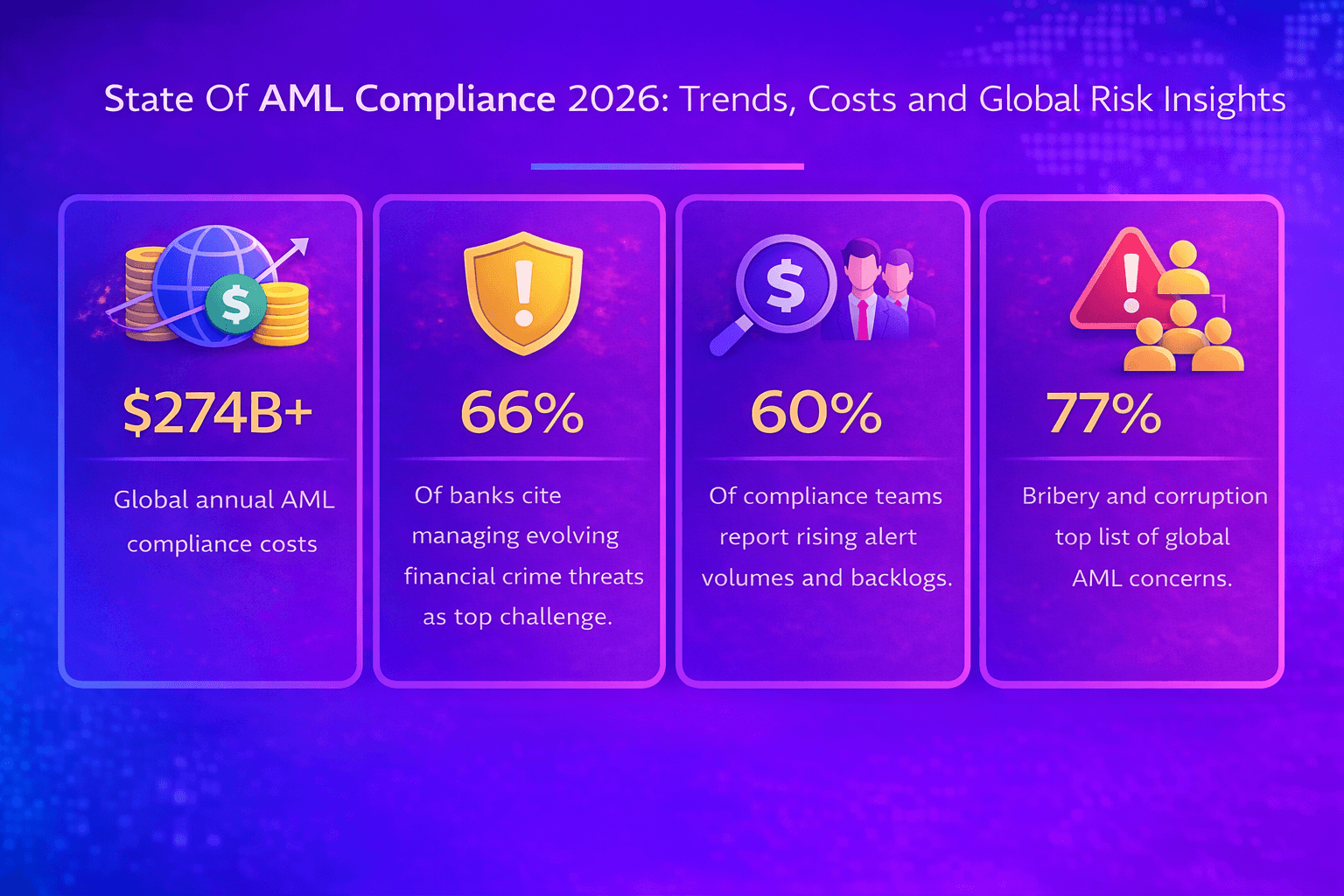
The Rising Cost Of AML Compliance
The cost of AML compliance has increased substantially over the past decade, driven by regulatory expansion, growing data volumes, and the need for more advanced technology.
Where Costs Are Increasing
The main drivers of rising compliance costs include:
Expanding regulatory requirements across multiple jurisdictions
Increased staffing to manage alert volumes and investigations
Investment in technology infrastructure and data systems
Ongoing monitoring and reporting obligations
Research from the International Monetary Fund analysis on financial crime and compliance costs highlights the growing financial burden of compliance, particularly for large global institutions operating across multiple regulatory environments.
Operational Cost Impact
From an operational perspective, high costs are closely linked to inefficiencies such as false positives, manual processes, and fragmented systems. Improving processes such as alert adjudication workflows and compliance decision logging can significantly reduce unnecessary expenditure.
The False Positive Problem In AML
False positives remain one of the most significant contributors to inefficiency in AML compliance. As highlighted in the dedicated false positive report, a large majority of alerts do not correspond to genuine risk.
Why False Positives Matter
False positives increase workload, reduce efficiency, and create operational bottlenecks that limit the ability of institutions to focus on genuine threats.
They also contribute to broader challenges such as alert fatigue, which is explored further in false positives and related compliance concepts.
Impact On Compliance Effectiveness
When systems generate excessive alerts, the ability to detect real financial crime is reduced. This creates a paradox where more alerts do not lead to better outcomes.
Regulatory Trends Shaping AML In 2026
Regulatory expectations continue to evolve, with a strong focus on effectiveness, transparency, and accountability.
Increased Focus On Effectiveness
Regulators are placing greater emphasis on outcomes rather than process. Institutions must demonstrate that their systems can identify genuine risk and produce meaningful results.
Demand For Explainability
There is increasing scrutiny around how compliance decisions are made, particularly where advanced technologies are used. Systems must provide clear, auditable reasoning for decisions.
Global Regulatory Alignment
Efforts to align regulatory frameworks across jurisdictions are continuing, although differences still exist. This creates complexity for institutions operating internationally.
Technology Trends Transforming AML Compliance
Technology is playing a central role in shaping the future of AML compliance, with institutions investing in new approaches to improve efficiency and accuracy.
Adoption Of AI And Machine Learning
Machine learning models are being used to improve detection accuracy and reduce false positives by analysing patterns and contextual data.
Real Time Screening And Payments
The growth of instant payments is driving the need for real time compliance systems. Solutions built on real time screening infrastructure are becoming essential for managing risk without delaying transactions.
Data Management And Enrichment
Improving data quality and enrichment processes enhances the effectiveness of screening systems. Strong watchlist management plays a key role in reducing unnecessary alerts.
Key Challenges Facing Financial Institutions
Despite technological advancements, financial institutions continue to face several persistent challenges in AML compliance.
Operational Complexity
Managing compliance across multiple systems, jurisdictions, and data sources creates significant complexity.
Scalability Issues
As transaction volumes increase, systems must scale without compromising performance or accuracy.
Resource Constraints
Compliance teams must balance limited resources with increasing workloads and regulatory expectations.
What Good AML Compliance Looks Like In 2026
Effective AML compliance in 2026 is defined by a combination of accuracy, efficiency, and adaptability.
Characteristics Of Effective Systems
Key features of modern compliance systems include:
High precision in alert generation
Strong data quality and governance
Real time processing capabilities
Transparent and auditable decision making
Strategic Focus Areas
Institutions that perform well in AML compliance focus on:
Reducing false positives and improving signal quality
Enhancing data management and integration
Implementing scalable, cloud based infrastructure
How To Use This Report
This report is designed to support multiple stakeholders across financial institutions.
Compliance teams can use these insights to identify inefficiencies and improve operational workflows. Decision makers can use the data to guide investment in technology and resource allocation. Strategy leaders can use the trends outlined to align compliance frameworks with future regulatory expectations.
Understanding these insights is critical for moving from reactive compliance to proactive risk management.
Key Takeaways
The current state of AML compliance highlights several critical themes shaping the industry.
Compliance costs continue to rise globally
False positives remain a major source of inefficiency
Regulatory expectations are increasing in complexity and scope
Technology is essential for improving accuracy and scalability
Institutions that invest in improving precision, data quality, and system design will be better positioned to meet regulatory expectations and manage financial crime risk effectively.