Sanctions Screening


Last Updated: March 2026
Based On Regulatory Guidance And Industry Analysis
Sanctions screening remains one of the most critical components of Anti Money Laundering compliance. However, accuracy continues to be a major challenge for financial institutions, with high false positive rates and inconsistent matching results affecting operational efficiency.
In 2026, the focus has shifted from simply detecting potential matches to improving the precision of those matches. Institutions are increasingly measured not just on whether they detect risk, but on how accurately and efficiently they do so.
Sanctions screening is no longer limited by data availability. It is limited by data quality and matching logic.
The Precision Paradox In Sanctions Screening
In 2026, many institutions face what can be described as the Precision Paradox. Improving detection coverage often comes at the cost of reduced precision, leading to increased false positives.
To avoid missing risk, systems are typically configured to be overly sensitive. However, this results in excessive alert volumes that reduce operational efficiency and dilute the value of true risk signals.
The challenge is not simply detecting more matches. It is detecting the right matches with a level of precision that allows compliance teams to act effectively.
Why Sanctions Screening Accuracy Matters Now
The increasing volume of global transactions, combined with expanding sanctions lists and regulatory expectations, has made accuracy a central concern in compliance operations.
Regulators expect institutions to demonstrate that their screening systems are both effective and proportionate. Guidance from the Financial Action Task Force recommendations reinforces the need for balanced screening approaches that minimise unnecessary alerts while maintaining detection capability. Excessive false positives can indicate poor system design, while missed matches can expose institutions to significant risk.
As a result, accuracy is no longer a technical metric. It is a regulatory and operational priority.
Supervisory expectations reflected in the Financial Conduct Authority financial crime guidance also reinforce the importance of proportionate controls, defensible decisioning, and effective screening outcomes.
The Accuracy Problem In Sanctions Screening
In many institutions, sanctions screening systems generate large volumes of alerts that do not correspond to genuine risk. This creates inefficiencies and reduces the effectiveness of compliance operations.
The Signal To Noise Problem
One of the most significant challenges is the imbalance between true risk signals and irrelevant matches.
This creates what can be described as the Signal To Noise Problem, where compliance teams must process large volumes of low value alerts to identify a small number of meaningful cases.
The Matching Precision Gap
Many systems rely on basic matching techniques that do not account for context, leading to inaccurate results.
The Matching Precision Gap refers to the difference between how systems match names and how risk should actually be assessed.
Key Sanctions Screening Accuracy Statistics
Understanding screening accuracy requires examining industry benchmarks and operational data.
Industry Benchmarks
Understanding screening accuracy requires examining how data quality, matching logic, and system configuration interact. These benchmarks provide a realistic view of performance across financial institutions.
Metric | Estimated Range | Context |
|---|---|---|
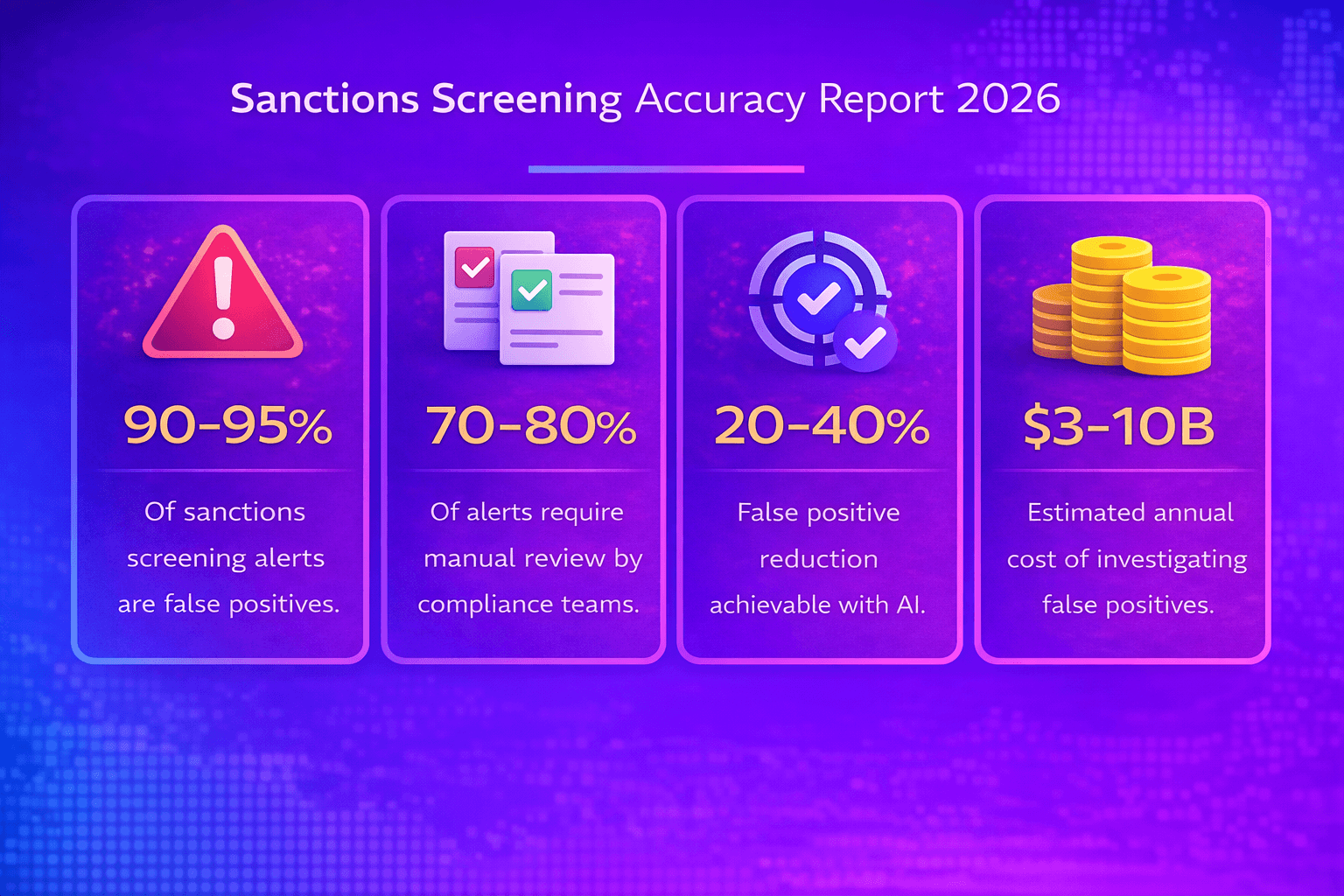
False Positive Rate | 85% – 95% | Name screening systems |
Match Precision | Low to Moderate | Dependent on system design |
Investigation Time | 20 – 60 minutes | Manual review processes |
Watchlist Size | Millions of records | Global sanctions lists |
Alert Volumes | Thousands per day | Large institutions |
These benchmarks reflect widely observed patterns across financial institutions and highlight the challenges of maintaining accuracy at scale.
For deeper insights into alert inefficiency, see AML false positive report and false positive rates in AML screening.
What These Numbers Mean
These figures reflect a structural imbalance in how screening systems are designed. Many systems prioritise coverage over precision, leading to excessive alert volumes that do not translate into meaningful outcomes.
This reinforces the need for systems that are designed to prioritise decision quality rather than simply maximising detection.
There is also a second order effect that is often missed. When analysts are repeatedly exposed to weak alerts, institutions do not just lose time. They weaken the consistency of human judgement across the review process. In practice, poor screening accuracy becomes both a technology problem and a decision quality problem.
These figures indicate that many screening systems prioritise recall over precision, generating large volumes of alerts to avoid missing risk.
However, this approach creates inefficiencies and increases operational burden, reinforcing the need for more balanced and intelligent matching strategies.
What Causes Low Accuracy In Screening Systems
Sanctions screening accuracy is affected by several structural factors.
Name Matching Limitations
Variations in spelling, transliteration, and cultural naming conventions create challenges for accurate matching.
For example, a name written in Cyrillic or Arabic may be transliterated into multiple valid English spellings. A single individual could therefore appear differently across datasets, causing systems to either miss a match or generate multiple incorrect alerts when similar names are present.
Poor Data Quality
Incomplete or inconsistent data reduces the ability to distinguish between individuals. Analysis from the Bank for International Settlements on data and financial risk highlights how data quality directly impacts the effectiveness of risk management systems.
Incomplete or inconsistent data reduces the ability to distinguish between individuals.
Static Matching Rules
Rule based systems lack the flexibility to adapt to complex scenarios.
High performing screening systems increasingly combine deterministic rules with probabilistic scoring, allowing institutions to evaluate both exact matches and contextual similarity in parallel. This significantly improves decision quality without increasing alert volume unnecessarily.
Overly Broad Watchlists
Large and unfiltered lists increase match frequency without improving detection quality.
The Cost Of Poor Screening Accuracy
Low accuracy has direct financial and operational consequences.
Operational Cost
High volumes of false positives increase workload and staffing requirements.
Compliance Risk
Missed matches can lead to regulatory breaches and financial penalties.
Customer Impact
Incorrect matches can delay transactions and negatively affect customer experience.
In high volume environments, this can quietly reshape commercial performance. Delays, repeated reviews, and inconsistent outcomes create friction that customers may interpret as unreliability, even when the institution is attempting to manage risk appropriately.
Technology Trends Improving Screening Accuracy
Financial institutions are adopting new approaches to improve accuracy.
Fuzzy Matching And Advanced Algorithms
Modern systems use advanced matching techniques to improve accuracy and reduce false positives.
Data Normalisation And Enrichment
Improving data quality enhances matching precision.
The strongest programmes treat data normalisation as a control layer rather than a back office clean-up exercise. When names, aliases, jurisdictions, and identifiers are standardised effectively before matching, screening quality improves at the point where decisions are actually made.
AI And Machine Learning
Machine learning models analyse patterns and context to improve detection.
Advanced systems now incorporate graph based techniques and entity resolution models to identify indirect relationships between individuals, improving detection capability without increasing noise.
Integrated Screening Systems
Systems such as customer screening, watchlist management, and payment screening work together to improve accuracy and reduce fragmentation across compliance workflows.
What Good Screening Accuracy Looks Like In 2026
Effective screening systems balance detection capability with operational efficiency.
In sanctions screening, accuracy is not just about reducing false positives. It is about ensuring that every alert has a defensible reason to exist.
Key Characteristics
Effective sanctions screening accuracy is not achieved through a single improvement, but through a combination of system design, data quality, and decision logic working together. High performing institutions build systems that are capable of distinguishing genuine risk from noise while maintaining operational efficiency at scale.
These characteristics reflect how mature screening environments are structured in practice.
High precision in matching
Reduced false positives
Context aware decision making
Scalable infrastructure
Strategic Focus Areas
To improve screening accuracy, institutions must shift from static rule based approaches to more adaptive and context aware systems.
This includes leveraging real time screening infrastructure to ensure that matching decisions are both fast and accurate.
The most mature institutions also separate three distinct objectives that are too often blended together: broad detection coverage, operational efficiency, and evidentially defensible alerts. Treating these as separate design goals leads to more precise controls and stronger compliance outcomes.
Institutions should focus on:
Improving data quality
Enhancing matching logic
Reducing unnecessary alerts
How To Use This Report
This report is designed to support compliance teams, risk leaders, and decision makers.
Compliance teams can use these insights to improve screening workflows and reduce false positives. Risk leaders can use the analysis to refine detection strategies. Decision makers can use the report to guide investment in data, technology, and system design.
Key Takeaways
Sanctions screening accuracy is a critical factor in effective AML compliance.
High false positive rates remain a major challenge
Matching precision is key to improving efficiency
Data quality plays a central role in accuracy
Technology is essential for modern screening systems