AML Compliance


Last Updated: March 2026
Based On Regulatory Guidance And Industry Data
Real time payments are transforming the global financial system, enabling instant fund transfers across borders and institutions. However, this speed introduces significant compliance challenges, particularly in Anti Money Laundering screening and financial crime prevention.
Unlike traditional batch based systems, real time payments require immediate decision making. Transactions must be screened, assessed, and either approved or blocked within seconds. This creates a fundamental shift in how compliance systems operate.
Guidance from the Financial Action Task Force emphasises that financial institutions must maintain effective controls even in high speed environments. At the same time, regulators such as the Financial Conduct Authority continue to highlight the importance of balancing speed with risk management.
This report explores the key risks, operational challenges, and emerging trends shaping real time payments compliance in 2026.
AML compliance is no longer constrained by data availability. It is constrained by decision speed.
Why Real Time Compliance Matters Now
The rapid growth of instant payment systems, combined with increasing regulatory scrutiny, means that compliance failures in real time environments are more visible and more consequential than ever.
Institutions are no longer judged solely on whether they detect risk, but on how effectively they manage it within increasingly compressed timeframes.
The Instant Decision Problem
In real time payment environments, compliance systems are forced to make decisions in milliseconds, often with incomplete or fragmented data.
This creates what can be described as the Instant Decision Problem. Institutions must either approve, block, or escalate a transaction immediately, without the benefit of extended investigation or contextual enrichment.
This introduces a new form of risk. Decisions are no longer limited by detection capability, but by the quality of data and logic available at the moment of execution.
The Real Time Compliance Gap
In 2026, many institutions face what can be described as the Real Time Compliance Gap. This is the gap between transaction speed and the ability of compliance systems to make accurate, risk based decisions instantly.
As payment systems evolve to support instant processing, legacy compliance frameworks struggle to keep pace. Systems designed for delayed or batch processing are not equipped to handle high volume, low latency decisioning.
The challenge is not detecting risk. It is doing so in milliseconds without compromising accuracy.
“Speed does not remove risk from payments. It compresses it into a narrower window where mistakes become more costly.”
Key Real Time Payments Compliance Statistics
Understanding the scale of real time payments requires examining key operational and industry benchmarks. While figures vary globally, consistent patterns are emerging across financial systems.
Industry Benchmarks
Understanding real time payment compliance requires examining how speed, volume, and decision making constraints interact within modern financial systems. These benchmarks provide a realistic view of operational expectations in instant payment environments.
Metric | Estimated Range | Context |
|---|---|---|
Real Time Payment Processing Speed | Seconds | Instant payment networks |
Transaction Volumes Growth | 20%+ annually | Global adoption trends |
Compliance Decision Time | < 1 second | Required for instant payments |
False Positive Sensitivity | High | Due to limited context |
Cross Border Payment Risk | Increasing | Multi jurisdiction complexity |
These benchmarks are widely reflected in regulatory commentary and industry research, highlighting the increasing pressure on compliance systems to operate at speed without sacrificing accuracy.
For related insights into screening inefficiencies, see AML false positive report and false positive rates in AML screening.
What These Numbers Mean For Compliance
The figures above reflect a fundamental shift in how compliance systems operate. Real time environments compress decision making into extremely short timeframes, forcing institutions to rely on pre-configured logic, risk scoring, and automated workflows.
This also changes the economics of compliance. In batch environments, inefficiency often appears as delay. In real time environments, inefficiency appears as either unnecessary friction for legitimate customers or insufficient intervention against genuine risk.
As payment volumes rise, institutions are effectively managing two risks at once: financial crime exposure and decision quality under time pressure.
The shift to real time payments introduces new operational constraints. Compliance systems must now operate within extremely tight timeframes, often with incomplete data.
This creates a trade off between speed and accuracy. Systems that prioritise speed risk increasing false negatives, while those prioritising caution risk blocking legitimate transactions.
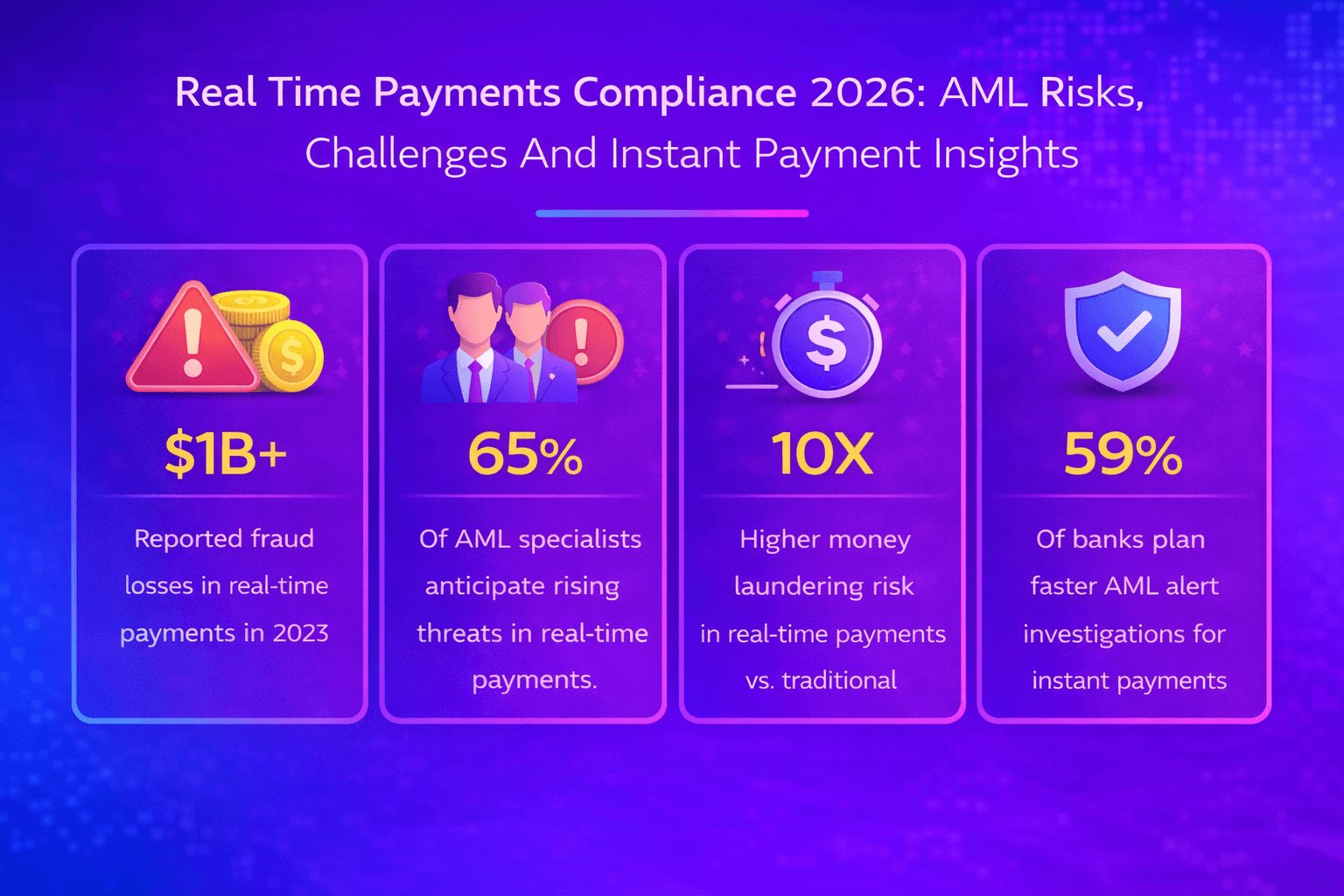
Why Real Time Payments Increase AML Risk
Real time payments fundamentally change the risk landscape for financial institutions. The immediacy of transactions reduces the window for intervention and increases the potential impact of financial crime.
Reduced Intervention Window
In real time payment systems, there is no meaningful delay between transaction initiation and settlement. This eliminates traditional checkpoints where suspicious activity could be reviewed or escalated before completion.
In traditional systems, transactions can be reviewed and flagged before settlement. Real time payments remove this delay, making prevention far more challenging.
Increased Fraud And Money Laundering Opportunities
The speed of real time payments allows criminal networks to rapidly move funds across accounts and jurisdictions, reducing the likelihood of detection and recovery.
Criminal networks exploit speed to move funds rapidly across accounts and jurisdictions, making detection and recovery more difficult.
Limited Data Availability
Real time payments often rely on limited structured data fields, restricting the depth of screening that can be performed at the point of transaction.
Instant payments often rely on minimal data fields, reducing the amount of information available for screening and risk assessment.
Cross Border Complexity
As real time payment networks expand globally, institutions must navigate multiple regulatory frameworks simultaneously, increasing compliance complexity.
Real time payment systems are increasingly interconnected globally, creating additional regulatory and jurisdictional challenges.
The Cost Of Real Time Compliance Failure
Failing to manage compliance effectively in real time payment environments can have significant consequences for financial institutions.
Financial Impact
Institutions face potential fines, operational losses, and increased compliance costs when systems fail to detect or prevent financial crime. Analysis from the Bank for International Settlements on payment system resilience and risk reinforces how operational weaknesses in fast payment environments can quickly become systemic concerns.
Reputational Risk
Failure to manage real time payment risks can damage trust and credibility with customers and regulators.
Operational Disruption
Blocking legitimate transactions or failing to process payments efficiently can impact customer experience and business operations.
This is why the most effective institutions do not treat real time compliance as a simple extension of traditional screening. They redesign controls around latency, prioritisation, and response quality.
Key Challenges In Real Time Payments Compliance
Real time payments introduce several structural challenges that require new approaches to compliance.
Decision Speed Vs Accuracy
Real time systems force a trade off between speed and precision. Systems optimised for speed may miss risk signals, while overly cautious systems can disrupt legitimate transactions.
Compliance systems must balance rapid decision making with accurate risk detection.
Legacy System Limitations
Many compliance infrastructures were designed for batch processing, making them unsuitable for real time environments where latency must be minimal.
Many institutions still rely on systems designed for batch processing, which are not suited to real time environments.
Data Fragmentation
Critical compliance data is often distributed across multiple systems, limiting the ability to perform comprehensive screening in real time.
Data required for effective screening is often distributed across multiple systems, making real time access difficult.
Alert Management At Scale
High transaction volumes combined with instant processing increase the complexity of managing alerts effectively, particularly when integrated with alert adjudication workflows.
High transaction volumes combined with instant processing increase the complexity of managing alerts effectively.
Technology Trends Enabling Real Time Compliance
Financial institutions are adopting new technologies to address the challenges of real time payments.
Real Time Screening Infrastructure
Modern compliance systems rely on real time screening infrastructure to process transactions instantly without delaying payment flows.
Systems built for real time processing enable instant decision making without delaying transactions.
AI And Machine Learning
Machine learning models enhance detection by analysing behavioural patterns and contextual relationships in real time, reducing reliance on static rules.
Advanced models improve detection accuracy by analysing patterns and contextual relationships in real time.
Data Enrichment And Integration
Integrating additional data sources improves screening accuracy and reduces ambiguity in decision making.
Modern compliance architectures increasingly rely on integrated systems such as payment screening to ensure transactions are assessed instantly without introducing unnecessary friction.
Scalable Cloud Architecture
Cloud based systems enable scalability and low latency processing required for high volume real time payment environments.
What Effective Real Time Compliance Looks Like In 2026
Effective compliance in real time payment environments requires a combination of speed, accuracy, and adaptability.
Key Characteristics
Effective real time compliance systems share several core characteristics that enable both speed and accuracy in decision making.
Instant decision making capabilities
High precision in risk detection
Strong data integration and enrichment
Scalable and resilient infrastructure
Strategic Focus Areas
To remain effective in real time environments, institutions must prioritise specific areas of improvement.
This requires a shift from static control thinking towards dynamic decision design. The strongest programmes are not simply faster. They are architected to make better decisions within tighter operational limits.
Institutions should focus on:
Reducing false positives without increasing false negatives
Implementing real time screening systems
Enhancing data quality and availability
How To Use This Report
This report is designed to support compliance teams, technology leaders, and decision makers.
Compliance teams can use these insights to improve screening processes and reduce risk exposure. Technology leaders can use the findings to guide system upgrades and infrastructure investments. Decision makers can use the report to align compliance strategies with evolving regulatory expectations.
Key Takeaways
The evolution of real time payments is fundamentally reshaping how compliance operates across financial institutions.
Real time payments are reshaping AML compliance, creating new challenges and opportunities for financial institutions.
Speed introduces new compliance risks
Decision making must happen instantly
Technology is critical for managing real time risk
Data quality and integration are essential for accuracy
Institutions that invest in real time capable systems will be better positioned to manage financial crime risk and meet regulatory expectations.