AML Compliance


Last Updated: March 2026
Based On Regulatory Guidance And Industry Analysis
Fuzzy matching has become a foundational component of modern Anti Money Laundering screening systems. As financial institutions process increasing volumes of global data, the ability to identify similar but not identical matches is essential for effective compliance.
In 2026, fuzzy matching is no longer used in isolation. It is increasingly combined with artificial intelligence and machine learning techniques to improve accuracy, reduce false positives, and enhance detection capability.
Fuzzy matching is no longer just about similarity. It is about context, probability, and decision quality.
The Matching Confidence Gap
In 2026, many institutions face what can be described as the Matching Confidence Gap. This is the gap between a system identifying a potential match and the institution having enough confidence to act on that match decisively.
Traditional fuzzy matching generates similarity scores, but these scores alone do not provide sufficient context to determine risk. As a result, institutions are left with large volumes of alerts that require manual interpretation.
The challenge is not identifying similar records. It is assigning a level of confidence that supports consistent, defensible decisions.
Why Fuzzy Matching Matters In Modern AML Screening
The global nature of financial systems introduces significant complexity into name matching and identity verification. Variations in spelling, language, and data quality mean that exact matching alone is insufficient.
Fuzzy matching allows systems to identify potential matches even when data is inconsistent or incomplete. This capability is essential for detecting risk in real world scenarios where data is rarely standardised.
However, fuzzy matching also introduces challenges. Poorly configured systems can generate excessive false positives, creating operational inefficiencies and reducing the effectiveness of compliance teams.
Guidance from the Financial Action Task Force recommendations emphasises that institutions must apply proportionate, risk based controls, reinforcing the importance of balancing detection capability with precision.
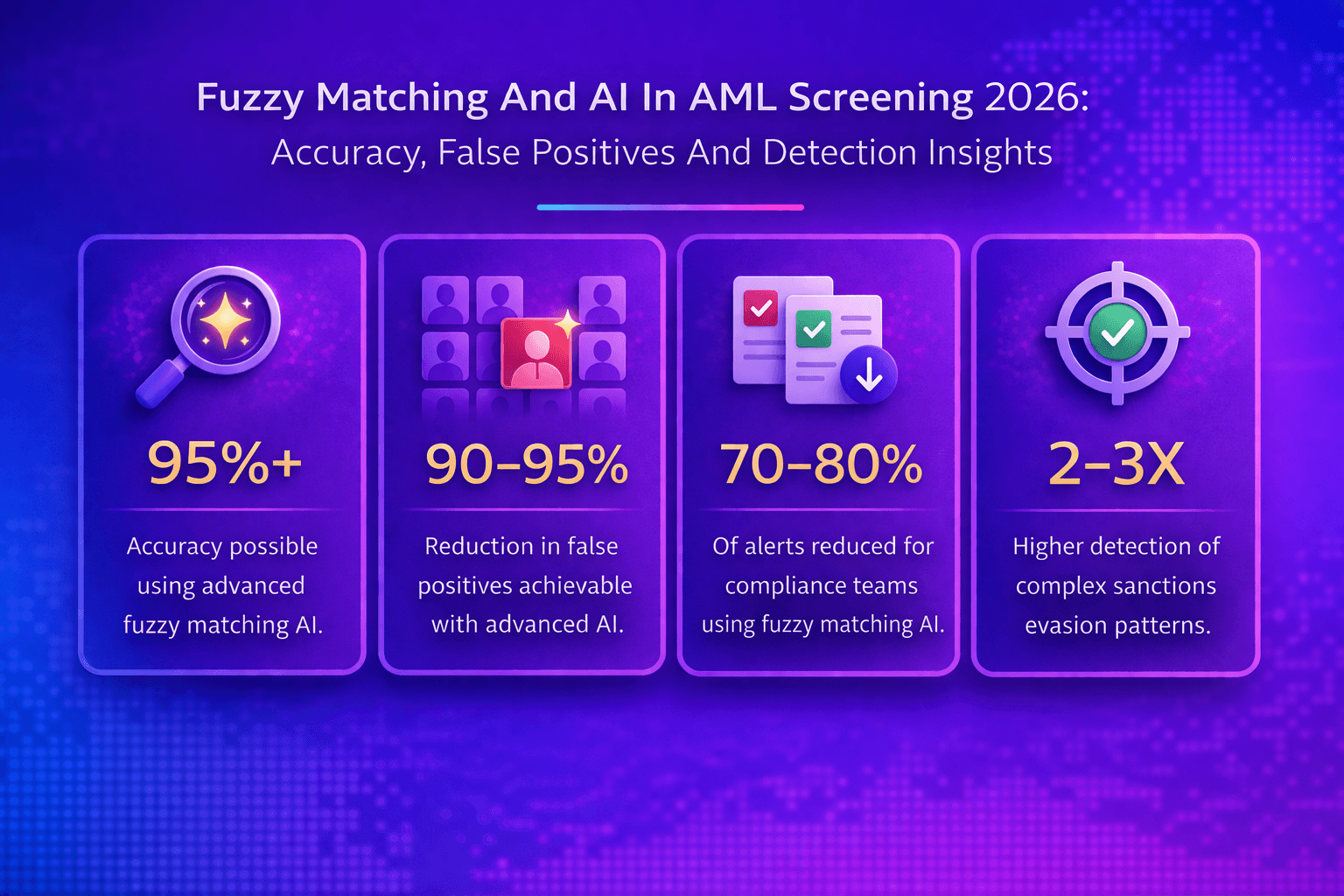
The Matching Accuracy Tradeoff
In AML screening, institutions must balance two competing priorities: detecting as many relevant matches as possible while minimising incorrect alerts.
This creates what can be described as the Matching Accuracy Tradeoff. Increasing sensitivity improves detection but also increases false positives. Reducing sensitivity improves precision but may miss genuine risk.
The challenge is not choosing one over the other. It is designing systems that can optimise both simultaneously.
For related analysis on alert inefficiency, see AML false positive report and false positive rates in AML screening.
How Fuzzy Matching Works In AML Systems
Fuzzy matching algorithms evaluate the similarity between strings rather than requiring exact matches. These algorithms assign scores based on how closely two pieces of data resemble each other.
Common Techniques
Effective fuzzy matching relies on a range of techniques, each designed to handle different types of variation in data.
Edit Distance Algorithms
These measure how many changes are required to transform one string into another.
Phonetic Matching
These identify names that sound similar even if they are spelled differently.
Token Based Matching
These compare individual components of names rather than entire strings.
The Role Of AI In Improving Matching Accuracy
Artificial intelligence enhances fuzzy matching by introducing context and adaptability.
Context Aware Matching
AI models can evaluate additional attributes such as location, nationality, and behaviour to improve decision making.
Supervisory expectations reflected in the Financial Conduct Authority financial crime guidance reinforce the importance of explainable and defensible decision making when using advanced technologies.
Adaptive Thresholds
Machine learning models can dynamically adjust matching thresholds based on risk profiles.
Pattern Recognition
AI identifies patterns that traditional rules cannot detect, improving detection capability.
Key Challenges In Fuzzy Matching Systems
Fuzzy matching introduces several challenges that institutions must address.
Over Sensitivity
Systems that are too sensitive generate excessive false positives.
Under Sensitivity
Systems that are not sensitive enough may miss genuine matches.
Data Quality Issues
Poor data quality reduces matching effectiveness. Analysis from the Bank for International Settlements on data and financial risk highlights how data quality directly impacts the reliability of financial crime detection systems.
Lack Of Context
Without additional data, systems struggle to distinguish between similar individuals.
Technology Trends In Fuzzy Matching
Modern AML systems are evolving rapidly.
AI Driven Matching
AI enhances traditional matching techniques with contextual analysis.
Modern architectures increasingly integrate customer screening, watchlist management, and payment screening to ensure consistency across detection workflows.
Entity Resolution
Systems identify relationships between individuals across datasets.
Graph Based Analysis
Graph techniques improve detection by analysing connections between entities.
What Effective Fuzzy Matching Looks Like In 2026
High performing systems combine multiple techniques to achieve accurate and efficient matching.
Key Characteristics
Effective fuzzy matching systems are designed to balance detection capability with operational efficiency. They must be capable of identifying meaningful matches while avoiding unnecessary alerts that create noise within compliance workflows.
These characteristics reflect how advanced screening systems are structured in practice.
Context aware matching
Adaptive thresholds
High precision and recall balance
Integration with broader screening systems
Strategic Focus Areas
Institutions should focus on improving the overall decision architecture rather than isolated components of the matching process.
This includes leveraging real time screening infrastructure to ensure that matching decisions are both fast and accurate, while maintaining consistency across systems.
The most advanced institutions also distinguish between similarity scoring, risk scoring, and decision scoring, ensuring that each stage of the process is optimised independently.
Improving data quality
Enhancing matching algorithms
Integrating AI capabilities
How To Use This Report
This report is designed to support compliance teams, risk leaders, and decision makers.
Compliance teams can use these insights to improve screening workflows and reduce false positives. Risk leaders can refine detection strategies. Decision makers can guide investment in AI and matching technologies.
How To Use This Report
This report is designed to support compliance teams, risk leaders, and decision makers.
Compliance teams can use these insights to refine matching workflows and reduce unnecessary alerts. Risk leaders can improve detection strategies and ensure consistency in decision making. Decision makers can guide investment in AI, data quality, and system design.
Key Takeaways
Fuzzy matching and AI are essential for modern AML screening.
Fuzzy matching enables detection in complex data environments
AI improves accuracy and reduces false positives
Data quality is critical for effective matching
Advanced techniques enhance detection capability