
False Positive Reduction in Sanctions Screening
False Positive Reduction in Sanctions Screening
Financial institutions often generate large volumes of alerts when screening customers or payment transactions against sanctions lists. Many of these alerts result from partial name matches, transliteration differences, or incomplete data. While screening systems must remain sensitive enough to detect sanctioned entities, excessive false positives can slow compliance operations and overwhelm investigation teams. Facctum’s screening and adjudication solutions help organisations improve match accuracy and reduce unnecessary alerts through configurable thresholds, intelligent scoring models, and advanced alert adjudication workflows. Compliance teams can manage screening rules, tailor screening profiles, and prioritise alerts more effectively while maintaining strong financial crime controls.
Why False Positives Occur in Sanctions Screening
Why False Positives Occur in Sanctions Screening
Screening systems must compare customer or payment data against large global watchlists containing millions of entities, aliases, and alternative spellings. Even minor variations in names, addresses, or identifiers can trigger alerts. Without flexible screening configurations and effective adjudication tools, institutions may face significant operational challenges.
Screening systems must compare customer or payment data against large global watchlists containing millions of entities, aliases, and alternative spellings. Even minor variations in names, addresses, or identifiers can trigger alerts. Without flexible screening configurations and effective adjudication tools, institutions may face significant operational challenges.
Screening systems must compare customer or payment data against large global watchlists containing millions of entities, aliases, and alternative spellings. Even minor variations in names, addresses, or identifiers can trigger alerts. Without flexible screening configurations and effective adjudication tools, institutions may face significant operational challenges.
Large Global Watchlists
Sanctions, PEP, and regulatory watchlists contain extensive entity data, including multiple aliases and transliterations. Basic matching logic can trigger alerts for many legitimate customers with similar names.
Large Global Watchlists
Sanctions, PEP, and regulatory watchlists contain extensive entity data, including multiple aliases and transliterations. Basic matching logic can trigger alerts for many legitimate customers with similar names.
Large Global Watchlists
Sanctions, PEP, and regulatory watchlists contain extensive entity data, including multiple aliases and transliterations. Basic matching logic can trigger alerts for many legitimate customers with similar names.
Inconsistent Data Quality
Customer and payment data may contain spelling variations, missing identifiers, or formatting inconsistencies, increasing the likelihood of false matches.=
Inconsistent Data Quality
Customer and payment data may contain spelling variations, missing identifiers, or formatting inconsistencies, increasing the likelihood of false matches.=
Inconsistent Data Quality
Customer and payment data may contain spelling variations, missing identifiers, or formatting inconsistencies, increasing the likelihood of false matches.=
Limited Screening Configuration
Systems with rigid screening thresholds can generate unnecessary alerts because they cannot adapt to different risk scenarios or customer segments.
Real-Time Payment Pressure
Systems with rigid screening thresholds can generate unnecessary alerts because they cannot adapt to different risk scenarios or customer segments.
Real-Time Payment Pressure
Systems with rigid screening thresholds can generate unnecessary alerts because they cannot adapt to different risk scenarios or customer segments.
Investigation Bottlenecks
Regulatory Complexity
Regulatory Complexity
When large numbers of alerts require manual review, compliance teams may struggle to prioritise investigations efficiently.
When large numbers of alerts require manual review, compliance teams may struggle to prioritise investigations efficiently.

Key Risks Created by Excessive False Positives
Key Risks Created by Excessive False Positives
Key Risks Created by Excessive False Positives
High false positive rates do not just affect efficiency. They can also create operational and regulatory risks for financial institutions.
High false positive rates do not just affect efficiency. They can also create operational and regulatory risks for financial institutions.

Large volumes of alerts can overwhelm compliance teams, delaying investigations and increasing operational risk.
Large volumes of alerts can overwhelm compliance teams, delaying investigations and increasing operational risk.
Large volumes of alerts can overwhelm compliance teams, delaying investigations and increasing operational risk.

Repeatedly reviewing low risk alerts can lead to alert fatigue, making it harder for analysts to identify genuine financial crime risks.
Repeatedly reviewing low risk alerts can lead to alert fatigue, making it harder for analysts to identify genuine financial crime risks.
Repeatedly reviewing low risk alerts can lead to alert fatigue, making it harder for analysts to identify genuine financial crime risks.

Regulators expect firms to demonstrate effective sanctions controls. Excessive false positives may indicate poorly configured screening systems.
Regulators expect firms to demonstrate effective sanctions controls. Excessive false positives may indicate poorly configured screening systems.

High alert volumes increase operational costs and reduce the overall effectiveness of financial crime prevention programmes.
High alert volumes increase operational costs and reduce the overall effectiveness of financial crime prevention programmes.
Core Capabilities for Reducing False Positives
Core Capabilities for Reducing False Positives
Facctum provides configurable screening and adjudication tools that help organisations improve screening accuracy and manage alerts more efficiently.
Facctum provides configurable screening and adjudication tools that help organisations improve screening accuracy and manage alerts more efficiently.

Configurable Screening Profiles
Customer screening profiles allow organisations to define match criteria and thresholds tailored to specific use cases or customer segments.
Configurable Screening Profiles
Customer screening profiles allow organisations to define match criteria and thresholds tailored to specific use cases or customer segments.
Configurable Screening Profiles
Customer screening profiles allow organisations to define match criteria and thresholds tailored to specific use cases or customer segments.

Flexible Threshold Management
Compliance teams can configure match thresholds to balance sensitivity and accuracy, reducing unnecessary alerts while maintaining strong sanctions controls.
Flexible Threshold Management
Compliance teams can configure match thresholds to balance sensitivity and accuracy, reducing unnecessary alerts while maintaining strong sanctions controls.
Flexible Threshold Management
Compliance teams can configure match thresholds to balance sensitivity and accuracy, reducing unnecessary alerts while maintaining strong sanctions controls.

Tailored Screening Lists
Segment specific screening lists allow institutions to screen customers against relevant datasets, improving precision and reducing irrelevant matches.
Tailored Screening Lists
Segment specific screening lists allow institutions to screen customers against relevant datasets, improving precision and reducing irrelevant matches.
Tailored Screening Lists
Segment specific screening lists allow institutions to screen customers against relevant datasets, improving precision and reducing irrelevant matches.

AI Assisted Alert Adjudication
Facctum’s screening adjudicators apply scoring models and filters to assess potential matches and prioritise alerts for investigation.
AI Assisted Alert Adjudication
Facctum’s screening adjudicators apply scoring models and filters to assess potential matches and prioritise alerts for investigation.
AI Assisted Alert Adjudication
Facctum’s screening adjudicators apply scoring models and filters to assess potential matches and prioritise alerts for investigation.

Real Time Screening Engine
Facctum’s screening engine evaluates customer and payment data against watchlists in real time using configurable rules and thresholds.
Facctum’s screening engine evaluates customer and payment data against watchlists in real time using configurable rules and thresholds.
Centralised Watchlist Repository
A unified watchlist repository enables organisations to manage sanctions lists, PEP databases, and other regulatory datasets from a single platform.
A unified watchlist repository enables organisations to manage sanctions lists, PEP databases, and other regulatory datasets from a single platform.
Automated List Ingestion
Automated ingestion ensures that watchlist updates are processed quickly, allowing institutions to screen against the most current regulatory data.
Automated ingestion ensures that watchlist updates are processed quickly, allowing institutions to screen against the most current regulatory data.
Integrated Investigation Workflows
Alert adjudication tools support investigators by organising alerts, applying scoring models, and documenting investigation outcomes.
Alert adjudication tools support investigators by organising alerts, applying scoring models, and documenting investigation outcomes.
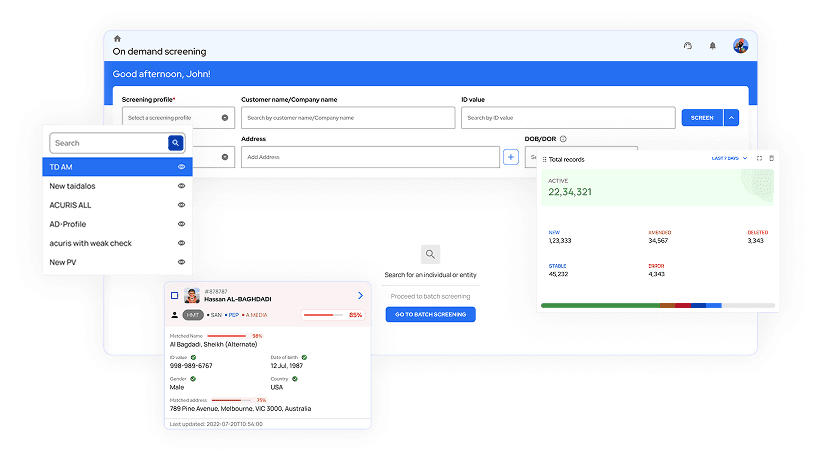
Technology Infrastructure Supporting Accurate Screening
Technology Infrastructure Supporting Accurate Screening
Modern financial institutions require screening systems capable of processing large volumes of data while maintaining high accuracy.
Modern financial institutions require screening systems capable of processing large volumes of data while maintaining high accuracy.
Why Leading Financial Institutions Trust Facctum
Why Leading Banks
Trust Facctum
Modern AML compliance requires more than isolated screening checks. Facctum provides financial institutions with the speed, reliability, and scale required to operate effective financial crime controls while maintaining regulatory readiness.
Modern AML compliance requires more than isolated screening checks. Facctum provides financial institutions with the speed, reliability, and scale required to operate effective financial crime controls while maintaining regulatory readiness.
ms
<80
Real-time results
Ultra Fast Screening
Facctum delivers real-time screening results in under 80 milliseconds. Whether processing SWIFT, SEPA Instant, or ISO 20022 payment messages, screening occurs instantly without slowing operational workflows.
Enterprise Grade Reliability
With 99.9 percent uptime, Facctum ensures compliance operations remain available even during peak transaction volumes. Compliance teams can maintain continuous screening and investigation workflows without interruption.
With 99.9 percent uptime, Facctum ensures compliance operations remain available even during peak transaction volumes. Compliance teams can maintain continuous screening and investigation workflows without interruption.
%
99.9
Always-on uptime
min
<5
Instant list updates
Continuous Compliance
Continuous Compliance
Regulatory watchlists are refreshed in under five minutes, ensuring screening systems always operate using the latest sanctions and compliance data.
Regulatory watchlists are refreshed in under five minutes, ensuring screening systems always operate using the latest sanctions and compliance data.
Scalable Infrastructure
Scalable Infrastructure
Facctum supports screening and watchlist management across millions of records. As financial institutions grow, the platform scales to support increasing screening volumes without compromising performance.
Facctum supports screening and watchlist management across millions of records. As financial institutions grow, the platform scales to support increasing screening volumes without compromising performance.
+
5M
Scalable watchlist records
Trusted by Compliance Teams Managing Financial Crime Risk
Trusted by Compliance Teams Managing Financial Crime Risk
Compliance teams rely on advanced screening technology to monitor customers, transactions, and counterparties against global sanctions lists.
Compliance teams rely on advanced screening technology to monitor customers, transactions, and counterparties against global sanctions lists.




Organisations use Facctum solutions to:
Screen customers against sanctions and PEP lists
Screen payment transactions in real time
Manage global watchlists from a centralised platform
Investigate alerts using structured adjudication workflows
Frequently Asked Questions
Frequently Asked Questions
Can Facctum handle real-time payment flows like SEPA Instant and SWIFT?
Is it suitable for greenfield neobanks?
Do you support jurisdiction-specific rules?
Can I replace or work alongside legacy systems?
What Is AML Compliance For Banks?
Show More
Can Facctum handle real-time payment flows like SEPA Instant and SWIFT?
Is it suitable for greenfield neobanks?
Do you support jurisdiction-specific rules?
Can I replace or work alongside legacy systems?
What Is AML Compliance For Banks?
Show More
Can Facctum handle real-time payment flows like SEPA Instant and SWIFT?
Is it suitable for greenfield neobanks?
Do you support jurisdiction-specific rules?
Can I replace or work alongside legacy systems?
What Is AML Compliance For Banks?
Show More

Strengthen Your Sanctions Screening Accuracy
Facctum’s screening and adjudication solutions help financial institutions reduce false positives, prioritise alerts effectively, and maintain strong financial crime controls.
Request a Demo
Strengthen Your Sanctions Screening Accuracy
Facctum’s screening and adjudication solutions help financial institutions reduce false positives, prioritise alerts effectively, and maintain strong financial crime controls.
Request a Demo

Solutions
Industries


Solutions

Solutions
Industries
Solutions
Industries
Solutions
Industries