
Crypto exchanges that support fiat onboarding operate within a regulatory environment that expects the same level of discipline applied in traditional financial services. When customers deposit or withdraw fiat funds, supervisors focus on the quality of sanctions controls, the consistency of decisions, and the evidence supporting those decisions. This page explains how exchanges can build screening processes that satisfy regulatory expectations while supporting fast onboarding and predictable payment flows. Each section is designed to give compliance leaders clear, actionable guidance they can apply immediately.
The aim is to provide a clear, practitioner focused view of what strong sanctions controls look like in a dynamic, high velocity environment.
Executive Summary
Fiat onboarding introduces regulatory obligations that require exchanges to demonstrate transparent decisions, disciplined list governance, and clear auditability. Strong screening foundations help exchanges maintain confidence in outcomes as customer volumes grow, reducing operational friction and strengthening the overall control framework. MLROs and compliance leaders can use this guidance to benchmark their screening environment against UK, EU, and US expectations.
Key Takeaways For MLROs
Senior compliance leaders can use these points to assess readiness:
Screening accuracy relies on structured data, transparent rule logic, and explainable match outcomes.
Thresholds must be supported with rationale grounded in recent behaviour and risk assessments.
Documentation and audit trails materially influence supervisory outcomes.
Adjudication layers help reduce noise at scale without weakening detection.
Why Sanctions Screening Matters For Crypto On-Ramps
Supervisors treat fiat deposits, withdrawals, and related payment activity as regulated financial activity. Exchanges must therefore apply sanctions controls that demonstrate consistent decision making and defensible governance. UK regulators emphasise evidence backed decisions.
EU authorities prioritise transparency and list governance. US regulators focus heavily on audit trails and dismissal justification.
Core Components Of Sanctions Screening For Crypto On-Ramps
An effective screening environment relies on accurate lists, transparent match logic, and structured workflows that make outcomes easy to trace and defend. Each component reinforces the others, creating a more stable and predictable control framework that remains effective under operational stress.
Watchlist Governance And List Integrity
Effective detection depends on current, structured lists with clear segmentation across customer onboarding and fiat flows. FacctList provides watchlist governance, ensuring consistent updates, normalisation routines, and alignment across systems.
Customer Screening During Fiat Onboarding
Exchanges must screen customer names and identifiers before enabling fiat access. FacctView offers configurable profiles, weighted scoring, and explainable match evidence to help analysts understand why an alert occurred.
Payment Screening For Fiat Deposits And Withdrawals
Fiat movements require real time screening of transaction context and counterparties. FacctShield applies structured rule logic and list governance to deposits and withdrawals.
Adjudication To Improve Alert Quality
Automated adjudication enriches match evidence and estimates the likelihood of a true hit. This reduces noise and helps analysts prioritise meaningful alerts.
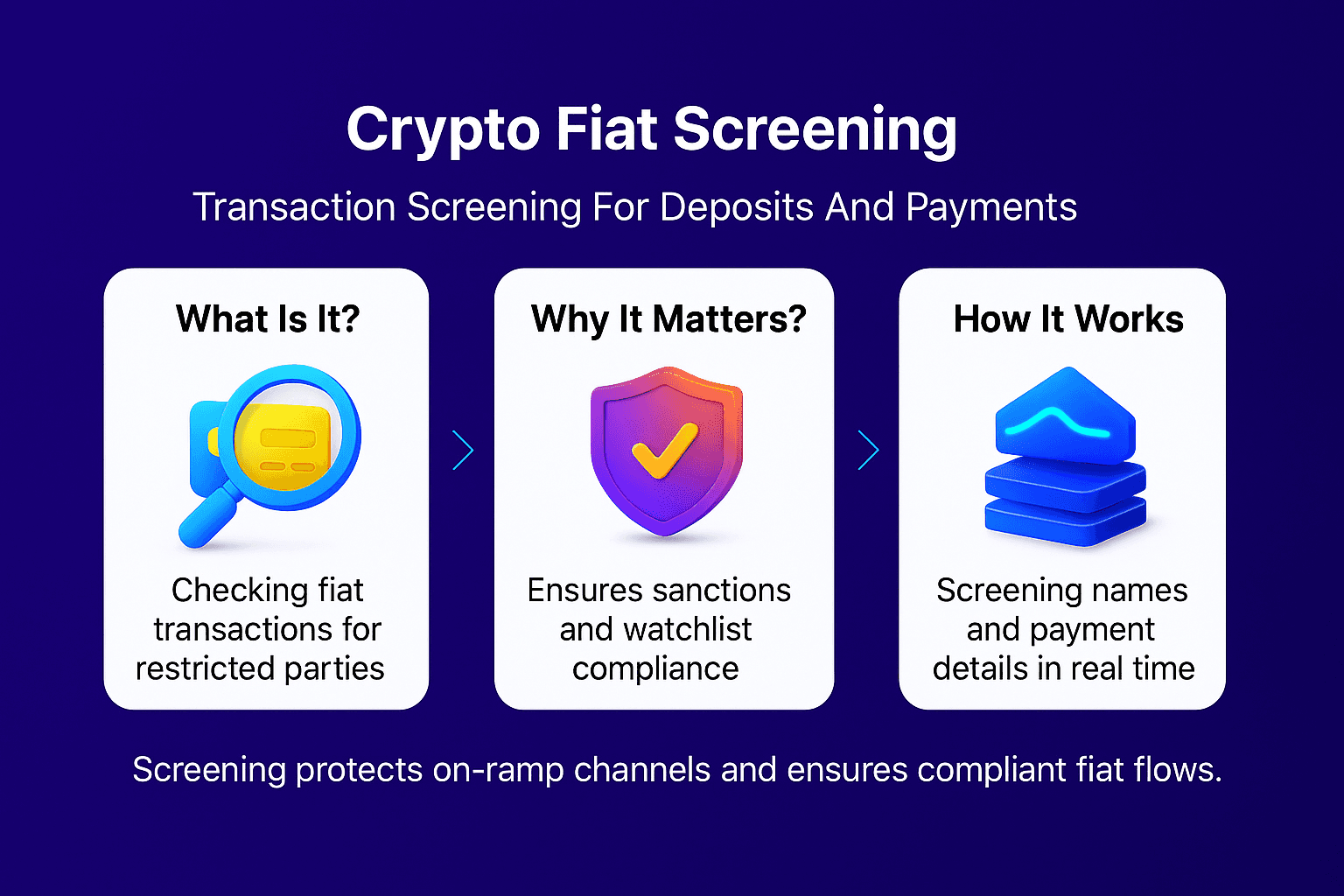
How Screening Decisions Are Made In Crypto Fiat Workflows
Screening performance depends on clear logic, thoughtful calibration, and disciplined review. Strong operational routines help maintain consistency across onboarding journeys, deposit behaviours, and diverse transaction types.
Evaluating Match Evidence
Weighted scoring highlights which attributes influenced a match, helping analysts assess its significance.
Analyst Review And Escalation
Analysts interpret evidence, apply internal policies, and document decisions in a traceable format aligned with supervisory expectations.
Documentation Expectations
Regulators expect clear justification for both true and dismissed alerts. Exchanges must show how decisions were reached and why certain rules or thresholds were applied.
Operational Challenges Crypto Exchanges Face In Fiat Screening
Customer behaviour and deposit patterns shift quickly, so screening controls must be able to adjust without creating instability. Adaptability in tuning and governance is essential for sustaining both accuracy and throughput without compromising customer experience.
High Onboarding Velocity
Fast sign up journeys create variability in data quality that can influence match outcomes.
Diverse Customer Profiles
Global user bases introduce naming conventions and formats that require flexible matching logic.
Instant Funding And Withdrawal Patterns
Real time deposits demand rules and adjudication models that maintain detection quality without slowing the customer experience.
What Good Looks Like In Crypto On-Ramp Sanctions Screening
Mature environments show strong governance, clear explainability, and consistent detection across all customer touchpoints. These characteristics give supervisors confidence that sanctions risks are being managed in a structured, transparent, and proportionate way.
Strong Governance And Clean Inputs
Reliable outcomes begin with accurate data, structured lists, and controlled update cycles.
Explainable Screening Logic
Clear rule behaviour and transparent evidence help supervisors understand why outcomes occurred.
Streamlined Alert Workflows
Adjudication layers reduce noise and improve analyst focus, especially during onboarding spikes.
Common Gaps Observed Across Crypto Fiat Screening Programs
Many exchanges encounter similar challenges as customer volumes and deposit activity scale, often revealing pain points that surface only when screening volumes increase or customer behaviour shifts suddenly.
Inconsistent Customer Data Quality
Incomplete or unstructured onboarding data undermines detection.
Overly Rigid Thresholds
Uniform thresholds generate excessive alerts across diverse profiles.
Limited Use Of Adjudication Layers
Manual triage alone cannot support high throughput environments.
How Crypto Exchanges Typically Strengthen Their Sanctions Screening Performance
Most improvement cycles begin with targeted analysis, followed by rule tuning and focused governance updates. Over time, these incremental adjustments create a more resilient and transparent control environment that can support sustained growth.
Step 1: Analyse Alert Drivers
Understanding which match attributes produce noise helps prioritise improvements.
Step 2: Improve List Governance
Structured list management enhances accuracy and reduces unnecessary alerts.
Step 3: Refine Thresholds And Adjudication
Calibrated rules and adjudication layers improve both detection and throughput.
Regional Screening Expectations Snapshot
Screening priorities vary across the UK, EU, and US.
United Kingdom: FCA Priorities
The FCA emphasises documented rationale for thresholds, evidence based decisions, and reliable validation cycles, as outlined in the FCA’s SYSC 6.3 financial crime guidance.
European Union: AMLD And EBA Guidance
EU authorities focus on transparent rule logic, structured list governance, and alignment with risk factor guidelines, consistent with the EBA ML/TF risk factor guidance.
United States: OFAC And FinCEN Expectations
US regulators require strict list governance, clear justification for dismissals, and auditable decision trails, as reflected in OFAC’s sanctions compliance guidance.
Sanctions Screening Maturity Model For Crypto Fiat On-Ramps
This maturity model shows how exchanges advance their controls.
Level 1: Basic Controls
Manual list updates.
Limited documentation.
One size fits all thresholds.
Level 2: Emerging Structure
Governance routines begin.
Partial adjudication.
Some decision rationale recorded.
Level 3: Established Screening Framework
Transparent rule behaviour.
Evidence based calibration.
Clear documentation.
Level 4: Advanced, Defensible Controls
Consistent governance.
Data driven tuning.
Explainable outcomes.
Capability Map For Effective Fiat On-Ramp Screening
An effective sanctions control framework relies on a set of well defined capabilities that reinforce one another. Gaps in any capability often create downstream inefficiencies, inconsistent decisions, or unclear audit trails.
List Governance Capability
FacctList supports segmentation, normalisation, and consistent list management, as described in our watchlist management page..
Customer Name Screening Capability
FacctView provides configurable matching and explainable evidence, reflecting the configuration principles used in our customer screening capability..
Payment Screening Capability
FacctShield applies structured logic to deposits and withdrawals.
Adjudication Capability
Automated adjudication estimates true hit likelihood and improves prioritisation.
Auditability And Documentation Capability
Traceable decisions support internal assurance and regulatory reviews.
Compliance Risk Scenarios Crypto Exchanges Should Prepare For
Supervisors often test whether exchanges can identify the risks most relevant to their business model and demonstrate how they are managed.
Scenario 1: Multiple Name Variations On Initial Deposit
Disparate naming formats require weighted scoring and adjudication to avoid missed detections.
Scenario 2: High Velocity Deposit Spikes
Scaling rules and adjudication helps screening keep pace with onboarding surges.
Scenario 3: Withdrawals To Higher Risk Jurisdictions
Geographic context must inform alerting thresholds and review processes.
Scenario 4: Partner Channels With Unfamiliar Profile Formats
List governance and structured scoring reduce uncertainty when integrating external partners.
Next Steps For Your Organisation
Exchanges preparing for regulatory engagement often begin by reviewing match drivers, threshold behaviour, and the strength of their documentation. These insights help shape practical improvement plans that enhance accuracy, defensibility, and operational confidence. Even small improvements in governance or adjudication can deliver measurable benefits.
If you would like practical guidance on improving match outcomes or aligning your screening environment with FCA, EU, or US expectations, you can reach out through our contact page to discuss a focused review shaped around the needs of your operating model and the regulatory expectations governing your markets.
Frequently Asked Questions
Why Do Crypto Exchanges Experience High Alert Volumes On Fiat On-Ramps?
How Can Exchanges Improve Accuracy Without Slowing Deposits?
What Role Does Watchlist Governance Play?
How Do UK Regulators Assess Screening Controls?
How Do EU Authorities Assess Screening Controls?
How Do US Regulators Assess Screening Controls?
Why Are Threshold Calibration Reviews Important For Crypto Fiat Screening?
How Can Exchanges Reduce False Positives During High Volume Periods?
What Documentation Do Supervisors Expect During A Screening Review?
How Do Exchanges Demonstrate Continuous Improvement In Their Screening Controls?