Sanctions Screening


Sanctions screening and financial crime monitoring systems are essential controls in modern compliance frameworks. Banks, fintech firms, payment institutions, and other regulated organisations rely on screening technology to identify potential matches with sanctioned individuals, politically exposed persons, or other high risk entities.
However, implementing a screening system is only the starting point. The more important question for compliance leaders is whether the system is actually effective. Screening effectiveness determines whether risks are being detected, whether investigators can manage alert volumes, and whether controls can withstand regulatory scrutiny.
For many organisations, measuring screening effectiveness is surprisingly difficult. Systems generate alerts, investigators clear cases, and reports are produced, but without the right metrics it is difficult to determine whether the control is truly working.
This guide explains how compliance teams measure screening effectiveness in practice, what metrics matter most, and how organisations can build a structured framework for evaluating the performance of sanctions and transaction screening systems.
Why Measuring Screening Effectiveness Matters
Financial institutions are expected to demonstrate that their financial crime controls operate effectively. Regulators increasingly focus not only on whether screening systems exist but whether those systems actually detect risk in a reliable and proportionate way.
Regulatory guidance emphasises that compliance controls should be risk based and proportionate to the institution's exposure. The Financial Action Task Force highlights this principle in its risk based approach for the banking sector, which explains how financial institutions should calibrate anti money laundering controls based on their risk profile.
When institutions cannot demonstrate screening effectiveness, regulators may question whether alerts are meaningful, whether investigations are consistent, or whether the system has been calibrated appropriately.
Measuring effectiveness helps organisations answer critical questions such as:
• Are genuine sanctions matches being detected?
• Are alert volumes manageable for investigators?
• Are false positives overwhelming the investigation team?
• Are high risk alerts prioritised appropriately?
• Are screening rules calibrated correctly?
Answering these questions requires a structured measurement framework rather than simple alert counts.
The Core Components Of Screening Effectiveness
Effective screening programmes rely on several interconnected elements. Measuring effectiveness therefore requires evaluating multiple parts of the screening ecosystem rather than focusing on a single metric.
Data Quality
Screening systems depend heavily on the quality of both sanctions list data and internal customer or transaction data.
If identifying attributes are missing or inconsistent, screening engines rely almost entirely on name matching, which increases the likelihood of false positives.
Organisations often improve screening reliability by strengthening list governance through structured list ingestion and consolidation processes supported by platforms such as a dedicated watchlist management solution that ensures sanctions lists are standardised, deduplicated, and enriched before screening takes place.
High quality reference data allows screening systems to make more accurate comparisons and reduces ambiguity during alert generation.
Matching Logic
Matching algorithms determine how similarities between screened entities and watchlist records are evaluated. These algorithms typically use fuzzy matching techniques to detect spelling variations, transliterations, and phonetic similarities.
If matching thresholds are configured too loosely, alert volumes can become overwhelming. If thresholds are too strict, genuine matches may be missed.
Measuring screening effectiveness therefore requires analysing how matching logic performs across real screening events.
Investigation Processes
Even the most advanced screening engines still rely on human investigators to review alerts and determine whether a match is genuine.
Structured investigation workflows supported by systems such as alert adjudication platforms allow investigators to apply consistent decision making processes, document investigative reasoning, and maintain clear audit trails.
Strong investigation workflows improve both operational efficiency and regulatory defensibility.
How Screening Systems Generate Alerts
Before measuring effectiveness, compliance teams must understand how screening systems actually produce alerts. Screening technology typically operates as part of a broader financial crime detection pipeline.
First, sanctions and regulatory lists are collected, standardised, and governed within a centralised watchlist repository. This ensures the screening engine compares customers and transactions against accurate and deduplicated data sources.
Next, screening engines evaluate customer or transaction attributes against these lists. Systems such as modern customer screening systems apply fuzzy matching logic, phonetic comparisons, and configurable similarity thresholds to detect potential matches.
If the calculated similarity score exceeds the configured threshold, the system generates an alert. This alert does not confirm a sanctions match. Instead, it signals that additional investigation is required.
Alerts then move into investigation workflows where analysts review additional identifying attributes, assess contextual information, and determine whether the alert represents a genuine sanctions match or a false positive.
Understanding this full pipeline is essential when evaluating screening performance because effectiveness depends on how well each stage of the process operates.
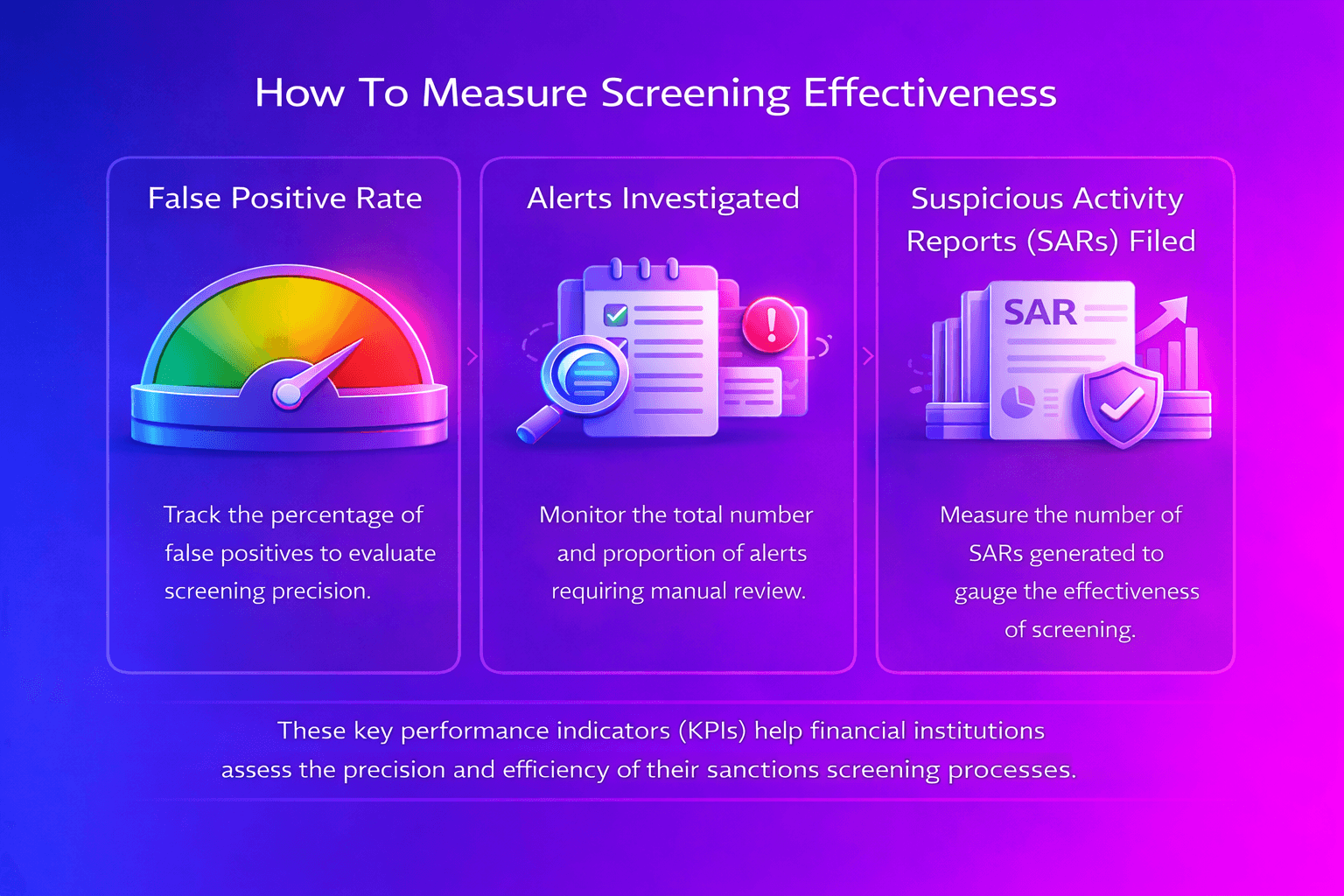
Key Metrics Used To Measure Screening Effectiveness
Compliance teams typically rely on a combination of operational, investigative, and risk based metrics when evaluating screening performance.
False Positive Rate
The false positive rate measures how many alerts generated by the screening system ultimately prove to be unrelated to sanctioned individuals or entities.
A high false positive rate indicates that the screening system is generating excessive noise. While some false positives are inevitable, extremely high rates may signal that matching thresholds or list data require adjustment.
True Positive Detection
True positives represent cases where the screening system correctly identifies a sanctioned entity or prohibited transaction.
Tracking true positive detection ensures that the system is successfully identifying genuine risk rather than simply generating large volumes of irrelevant alerts.
Alert Volume Per Customer Segment
Alert volumes should be analysed across different customer types, jurisdictions, and business lines.
Some segments may naturally generate more alerts due to naming conventions or geographic exposure. Understanding these patterns allows compliance teams to fine tune screening rules without weakening controls.
Investigation Resolution Time
The time required to investigate and close alerts provides insight into operational efficiency.
Long investigation times may indicate that investigators lack sufficient information, that workflows are inefficient, or that alert quality is poor.
Escalation Rates
Escalation metrics track how often alerts are escalated for enhanced review or regulatory reporting.
Consistently low escalation rates may indicate excessive false positives, while unusually high escalation rates may signal overly strict matching thresholds.
How Screening Effectiveness Is Evaluated In Practice
In real compliance environments, measuring screening effectiveness typically involves analysing the full screening lifecycle.
Step One: Screening Event
A screening event occurs when a customer, payment, or transaction is evaluated against sanctions lists.
The screening engine compares relevant attributes against reference data stored within the organisation's screening infrastructure.
Step Two: Alert Generation
When the similarity score exceeds a configured threshold, the system generates an alert for investigation.
The quality of alerts generated at this stage significantly influences the overall effectiveness of the screening programme.
Step Three: Alert Investigation
Investigators examine the alert using available identifying information such as name variations, dates of birth, nationality, and address data.
Structured investigation environments supported by tools such as Facctum's alert adjudication capability help investigators apply consistent review procedures and document investigative decisions.
Step Four: Outcome Analysis
Once alerts are closed, compliance teams analyse investigation outcomes to determine how many alerts were genuine matches and how many were false positives.
This analysis feeds back into screening rule calibration.
Common Challenges When Measuring Screening Effectiveness
Despite the importance of screening metrics, many organisations struggle to measure effectiveness accurately.
Limited Data Visibility
In some institutions, screening metrics are fragmented across multiple systems. Without consolidated reporting, it becomes difficult to analyse screening performance across the organisation.
Overreliance On Alert Counts
Some compliance programmes measure performance primarily through alert volumes. However, alert counts alone reveal little about whether screening systems are actually detecting genuine risk.
Inconsistent Investigation Documentation
If investigators record decisions inconsistently, it becomes difficult to analyse investigation outcomes or identify patterns in false positives.
Legacy Technology Constraints
Older screening systems may lack built in analytics capabilities, making it difficult to produce meaningful performance metrics.
What Effective Screening Measurement Looks Like
Organisations that successfully measure screening effectiveness typically adopt a structured monitoring framework.
Integrated Reporting
Screening metrics should be consolidated into a single reporting framework that tracks alert generation, investigation outcomes, and escalation decisions.
This allows compliance teams to analyse trends across time and across business segments.
Continuous Calibration
Screening rules should not remain static. Instead, institutions should regularly review performance metrics and adjust matching thresholds, rules, or data inputs accordingly.
Investigator Feedback Loops
Investigator insights are extremely valuable when assessing screening performance. Analysts often identify recurring patterns in false positives that may not be visible through automated metrics alone.
Capturing this feedback helps compliance teams refine screening configuration.
How Organisations Improve Screening Effectiveness
Improving screening effectiveness generally involves a combination of technology improvements, data governance, and operational process enhancements.
Improve Data Governance
High quality sanctions list management and customer data governance reduce ambiguity during screening and improve match accuracy.
Enhance Screening Configuration
Fine tuning fuzzy matching algorithms, similarity thresholds, and attribute weighting can significantly improve alert quality.
Strengthen Investigation Workflows
Structured investigation environments allow compliance teams to manage alerts more efficiently and document investigative decisions clearly.
Institutions often combine these improvements with guidance from industry resources and regulatory publications available through professional compliance knowledge resources such as the customer screening systems, which explores financial crime compliance topics in depth.
Leading Indicators Of Screening Failure
Compliance teams often discover weaknesses in screening systems only after a regulatory review or a major investigation. However, there are several early indicators that a screening programme may not be operating effectively.
Rapid Growth In Alert Volumes
A sudden increase in alerts without a corresponding increase in genuine matches often indicates that screening thresholds, list updates, or data quality issues are creating unnecessary noise.
Extremely High False Positive Rates
While false positives are unavoidable in sanctions screening, extremely high false positive rates can signal poorly calibrated matching logic or inconsistent data inputs.
Investigation Backlogs
If alert queues continue to grow faster than investigators can review them, the screening system may be generating alerts faster than the organisation can manage them. This reduces the effectiveness of financial crime controls.
Low True Match Detection
A system that produces large numbers of alerts but very few genuine matches may indicate that thresholds are too sensitive or that screening rules are poorly aligned with the organisation’s risk profile.
Inconsistent Investigation Outcomes
If different investigators reach different conclusions when reviewing similar alerts, this may indicate a lack of structured investigation processes or insufficient guidance for analysts.
Recognising these early indicators allows compliance teams to recalibrate screening configuration, improve list management, and strengthen investigation workflows before operational pressure escalates.
Professional Insight And Operational Confidence
Measuring screening effectiveness requires a holistic view of the entire screening lifecycle. Alert volumes, investigation outcomes, and escalation decisions all provide insight into how well the system is functioning. Organisations that monitor these indicators consistently can identify emerging weaknesses early and adjust screening configuration, data governance, or investigation procedures before performance deteriorates.
Practical Experience
Experienced compliance practitioners understand that screening effectiveness depends on the entire screening ecosystem rather than any single system component.
Improving data quality, screening configuration, and investigation processes together produces the strongest results.
Technical And Regulatory Expertise
Understanding regulatory expectations allows compliance teams to design screening frameworks that are both effective and defensible during regulatory reviews.
Building Confidence In Controls
When screening metrics demonstrate that alerts are meaningful, investigations are consistent, and genuine risks are detected, organisations gain confidence that their financial crime controls are operating effectively.
People First Compliance Content
Financial crime prevention ultimately depends on the expertise and judgement of compliance professionals. Technology can assist in identifying potential risk, but investigators must interpret information, assess context, and apply regulatory knowledge.
Educational resources like this aim to support compliance practitioners by explaining operational challenges and highlighting practical approaches to improving compliance controls.
Next Steps For Your Organisation
Many organisations discover that improving screening effectiveness requires a structured review of their current screening architecture, data governance processes, and investigation workflows.
Even small improvements to list management, screening thresholds, or investigation procedures can significantly improve both operational efficiency and risk detection.
If your organisation is reviewing its screening controls or evaluating improvements to its compliance infrastructure, explore how your screening framework compares with current industry practices.