Transaction Monitoring


Transaction monitoring is a cornerstone of anti-money laundering (AML) compliance. By analysing financial activity in real time, it enables institutions to detect unusual behaviour, prevent illicit transactions, and meet regulatory expectations.
Without effective monitoring, firms face heightened exposure to money laundering, sanctions breaches, and reputational harm. This article explains why transaction monitoring is essential, how regulators view it, and what best practices ensure compliance.
How Transaction Monitoring Works
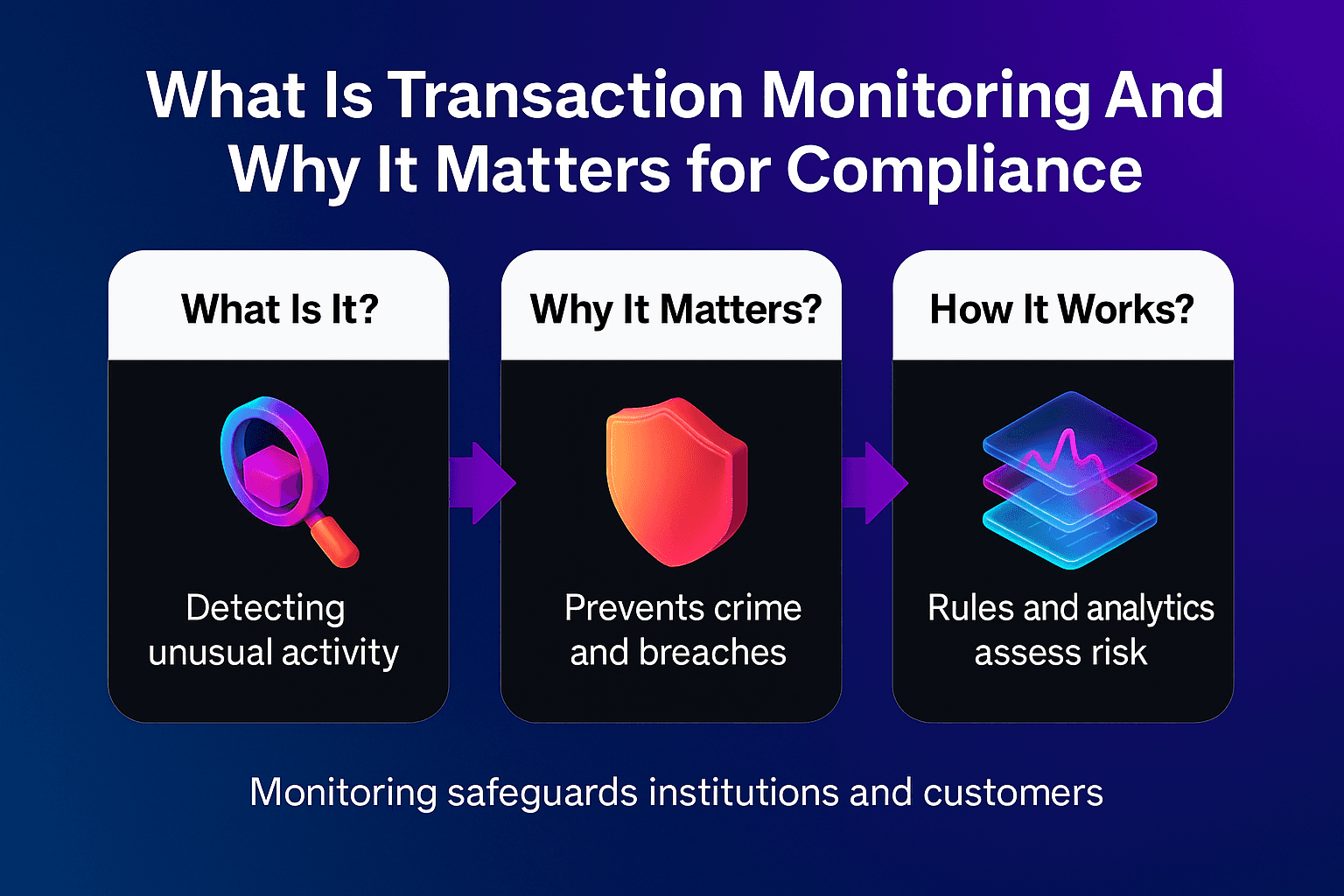
Transaction monitoring is the process of tracking and analysing financial activity to identify patterns of suspicious behaviour. It can be applied to payments, transfers, deposits, and withdrawals across multiple channels.
The goal is not only to block illegal activity but also to provide regulators with evidence that the institution has taken appropriate steps to manage financial crime risk.
Why Transaction Monitoring Is Essential for Compliance
According to the FATF Recommendations, financial institutions must monitor payments or value transfers to detect missing originator or beneficiary information and take appropriate action. In essence, this places transaction monitoring at the center of compliance frameworks.
The guidance states:
“Countries should ensure that financial institutions monitor payments or value transfers for the purpose of detecting those which lack required originator and/or beneficiary information and take appropriate measures.”
Firms are expected to monitor customer activity continuously and escalate alerts for investigation when thresholds are met. Weak monitoring frameworks have been the subject of enforcement actions worldwide, underlining its importance.
Key Compliance Benefits
Detects suspicious activity in near real time.
Helps firms comply with FATF Recommendations and local regulations.
Reduces the likelihood of regulatory penalties for oversight failures.
Regulatory Expectations in the UK, US, and Europe
Financial institutions in the UK, United States and Europe operate within well established financial crime frameworks. Although the principles behind transaction monitoring are broadly aligned, each region sets its own supervisory expectations that shape how firms design, calibrate and evidence their monitoring capabilities.
In the United Kingdom, the Financial Conduct Authority expects firms to maintain monitoring controls that reflect their business wide risk assessment. The FCA guidance on financial crime systems and controls sets out what effective monitoring should look like, including how alerts are reviewed and how decisions are documented. The regulator’s enforcement updates and public findings show that weaknesses in monitoring coverage, data quality and escalation processes remain common across the industry.
In the United States, the Financial Crimes Enforcement Network sets out the core requirements for an effective monitoring programme under the Bank Secrecy Act. FinCEN AML programme requirements explain how institutions should identify suspicious activity, escalate behaviour for review and submit required reports within the mandated timeframes. The United States Treasury Office of Foreign Assets Control supports this through its sanctions compliance framework which highlights the importance of maintaining real time screening and monitoring to prevent activity involving sanctioned individuals or jurisdictions.
Across the European Union, supervisory expectations continue to strengthen as the EU Anti Money Laundering Authority progresses toward a more harmonised approach. The European Banking Authority risk based AML and CFT guidelines outline how detection rules should be calibrated, how data should be maintained and how firms should identify behaviour that falls outside expected customer activity.
Although the specific language differs, regulators across the UK, US and Europe share a consistent expectation. Transaction monitoring should be proactive, data led and capable of identifying unusual behaviour as it emerges. Firms that cannot demonstrate this standard typically face remediation, increased supervisory attention or regulatory penalties.
Common Challenges in Transaction Monitoring
While critical, transaction monitoring is not without challenges. Many systems generate large numbers of false positives, overwhelming compliance teams.
Limitations Firms Face
False positives: Overly broad rules trigger unnecessary alerts.
Data fragmentation: Transactions across different systems are not always linked.
Evolving risks: New payment methods and typologies demand constant updates.
A research article on ScienceDirect highlights that traditional rules‑based methods used by banks generate high false positive rates, leading to increased costs and inefficiencies.
Best Practices for Improving Monitoring Accuracy
Transaction monitoring must evolve beyond legacy approaches to stay effective.
Combining Data and Analytics
Integrating structured data with external intelligence improves the ability to flag high-risk activity. For example, monitoring should capture not just transaction size but also links to known high-risk individuals.
Continuous Screening
Monitoring cannot be limited to onboarding. Ongoing analysis ensures that risks emerging after account opening are quickly identified.
Investigations and Alert Management
Alerts must be prioritised and managed efficiently. Solutions like Alert Adjudication help compliance teams focus on genuine threats instead of being overwhelmed by false positives.
How Technology Enhances Transaction Monitoring
Modern transaction monitoring depends on automation. Advanced solutions combine real-time screening with intelligent analytics to reduce false positives and improve efficiency.
Tools such as FacctShield, Payment Screening and FacctView, Customer Screening complement monitoring by ensuring payments and customer profiles are checked against watchlists and sanctions data.
Most importantly, FacctGuard, Transaction Monitoring enables firms to capture suspicious activity as it happens, strengthening AML defences while meeting global compliance standards.
Research shows that analysing transaction relationships using graph-based methods significantly enhances monitoring accuracy in financial crime detection
Final Thoughts on Strengthening Monitoring Programmes
Transaction monitoring is no longer optional, it is a regulatory expectation and a frontline defence against money laundering and other financial crimes. By combining real-time analysis, advanced matching, and continuous screening, firms can build more resilient AML frameworks.
Strengthen Your Monitoring Framework With FacctGuard
Protecting your organisation requires transaction monitoring that is fast, accurate, and scalable.
With FacctGuard, Transaction Monitoring, your institution can capture suspicious activity in real time, reduce false positives, and strengthen AML defences.
👉 Contact Facctum today to see how FacctGuard can transform your monitoring framework.