RegTech


Financial institutions now depend heavily on cloud services to run screening, monitoring, and investigative workflows. As this dependence grows, teams must understand how responsibilities are distributed between themselves and the provider. This is not a purely technical question. It shapes how controls operate, how oversight functions evolve, and how regulators interpret accountability.
The shared responsibility model offers a practical structure for making these boundaries clear. This article explores how the model works in real environments, why it matters, and how institutions can incorporate it into their governance frameworks.
Why This Topic Matters Now For Compliance And Risk Teams
Cloud adoption is no longer experimental. It supports onboarding, screening, transaction analysis, and investigative decisioning in many institutions. As these workflows expand, regulators have reinforced that firms remain fully accountable for how cloud based controls operate. This expectation is reflected in guidance such as FCA outsourcing expectations, which clarify that outsourcing does not transfer regulatory responsibility. Teams therefore need a grounded understanding of where their ownership begins and ends.
Core Concepts Explained Through Practical Scenarios
The shared responsibility model functions well as a principle, but practical application depends on context. Compliance teams often need clearer examples that show how ownership plays out when technology and operational processes intersect.
How Providers And Customers Share Control In Cloud Environments
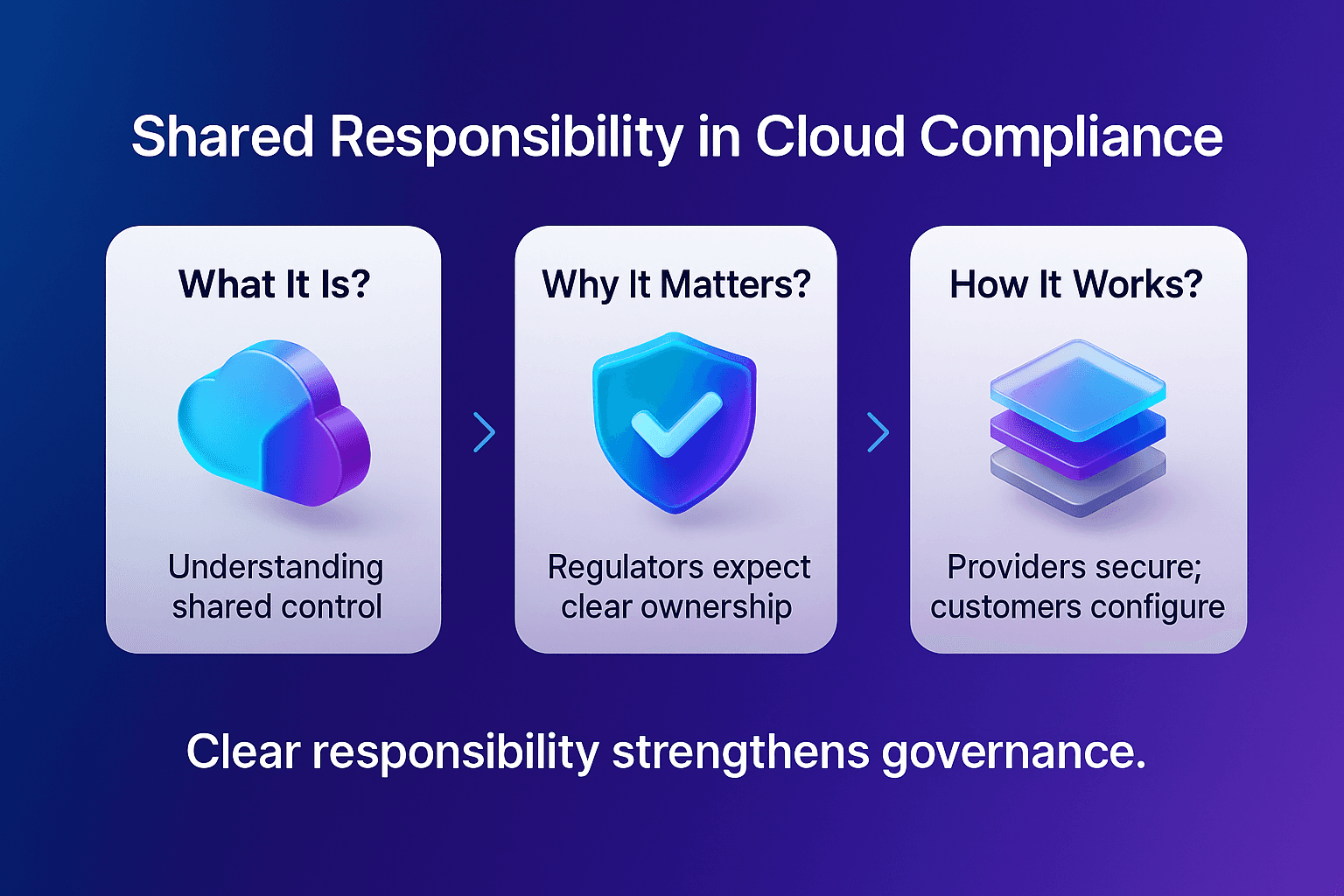
Cloud providers secure the infrastructure foundation, including data centres, networks, hardware, and virtualisation layers. Institutions take ownership of configuration decisions, rule application, workflow logic, and user governance. This structure allows providers to manage stability while customers retain control over how risk management processes function.
Why Ownership Gaps Create Operational Risk
When responsibilities are unclear, teams may assume tasks are handled by the provider when they are not. A frequent example involves user activity monitoring. Providers secure access to the environment, but they do not govern customer users working inside it. This misunderstanding can introduce avoidable control weaknesses.
Where Documentation Supports Better Governance
Clear documentation often becomes the mechanism that stabilises shared responsibility. Institutions that reference structured frameworks such as the EBA ICT and security risk guidelines tend to create stronger ownership matrices, configuration records, and oversight routines. These resources help teams translate technical boundaries into operational practice.
Practical Implications For Screening, Monitoring, And Investigations
The model influences everyday processes more than many teams expect. Screening accuracy, alert quality, and case outcomes are shaped by configuration choices made by the institution. Teams define thresholds, tune matching logic, and determine how exceptions should be handled. Providers maintain the platform, but customers drive the behaviour of detection systems.
During onboarding and ongoing due diligence, many institutions refine controls by reviewing their customer screening workflows. These reviews help teams identify where tuning, escalation models, or exceptions could create operational gaps.
Industry Wide Challenges With Cloud Responsibility Models
Institutions consistently encounter similar challenges when integrating cloud services into their compliance operations.
Unclear Change Ownership Between Functions
Change requests for rules, workflows, or platform behaviour often sit between compliance, technology, and security functions. Without defined ownership, changes become slow to approve or undocumented, increasing audit exposure.
Overestimating Provider Responsibilities
A recurring misconception is that providers validate detection logic or monitor internal behaviour. Providers focus on availability, infrastructure security, and platform performance. Customers remain responsible for how data is used and how detection workflows operate.
Weak Audit Evidence For Cloud Based Controls
Regulators expect institutions to demonstrate how responsibilities are assigned and executed. Missing access reviews, incomplete logs, or undocumented configuration changes all weaken assurance.
Where Improvements Usually Begin In Cloud Governance
Many teams start by mapping responsibilities across compliance, technology, and operational groups. These exercises often reveal gaps in change processes, access governance, configuration maintenance, and oversight routines.
Many teams supplement internal reviews with wider learning resources, often using the knowledge hub to explore themes related to governance, oversight, and control design
Operational, Technical, And Regulatory Insight For Practitioners
Shared responsibility requires alignment across teams. Effective governance depends on how operational, technical, and regulatory expectations combine.
Operational Practice That Improves Day To Day Outcomes
Operations teams function best when they understand how alerts form, how rules behave, and how investigators work cases. This awareness helps them identify emerging issues early and prevents reactive governance.
Technology Considerations That Influence Control Quality
Teams must maintain visibility into access rights, configuration integrity, and system behaviour. Research on cloud resilience, including BIS analysis on cloud risk, reinforces the importance of treating technology and governance as a single interconnected system.
Regulatory Expectations That Shape Governance Models
Supervisory themes consistently highlight the need for clear documentation, monitoring routines, and supplier oversight. Regulators expect firms to demonstrate their understanding of shared responsibility through everyday practice.
Taking Time To Review Governance Models Periodically
Many institutions benefit from intentionally stepping back to assess their cloud governance maturity. These reviews often highlight small adjustments that improve control clarity or reduce operational friction. A structured reflection can support both internal assurance and regulatory confidence.
How Modern Solutions Support More Effective Responsibility Models
Modern platforms are designed to help institutions manage configuration, workflow design, and ownership boundaries more clearly. Providers maintain security and availability while customers define how detection, escalation, and investigation processes work.
Institutions often improve governance effectiveness when they strengthen watchlist management practices. This is because rule behaviour, list governance, and data quality all sit firmly within customer responsibility.
Strategic Considerations For Leaders Managing Cloud Transformation
Leaders guiding cloud transformation must ensure their organisational structure supports the shared responsibility model. This includes designing ownership models, reinforcing supplier oversight, improving change control routines, and equipping teams with documentation standards that are defensible and repeatable.
Final Reflections And Next Steps For Teams
The shared responsibility model gives institutions a structured way to interpret their obligations in cloud environments. It clarifies the relationship between provider controls and customer owned processes. Teams looking to strengthen governance often begin by reviewing documentation, mapping ownership, and testing oversight routines.
Institutions ready to explore improvements or validate their current governance approach can contact Facctum to discuss emerging practices and peer insights.