AML Compliance

Financial institutions screen payment messages to detect sanctioned individuals, entities, and jurisdictions before transactions are processed. For decades this screening has relied on SWIFT payment messages, which contain structured fields used to identify originators, beneficiaries, and intermediary banks.
However, the global payments industry is undergoing a major transformation as financial institutions migrate toward ISO 20022 messaging standards. These new message formats provide significantly richer data than traditional SWIFT formats, creating new opportunities for improving sanctions screening accuracy.
Understanding the differences between SWIFT and ISO 20022 payment messages is therefore essential for compliance teams responsible for payment monitoring and sanctions detection. The structure of payment data directly affects how screening engines evaluate transactions and how investigators interpret alerts.
This guide explains how SWIFT and ISO 20022 messages differ, how those differences affect sanctions screening, and what financial institutions must consider as payment infrastructures evolve.
Why Payment Message Structure Matters For Screening
Sanctions screening engines rely heavily on the information contained within payment messages. If identifying information such as names, addresses, or account details is incomplete or poorly structured, screening systems may struggle to identify potential matches.
Traditional SWIFT MT messages were designed decades ago when payment infrastructures prioritised speed and interoperability rather than detailed data transparency. As a result, many SWIFT messages contain limited information about the parties involved in a transaction.
Modern payment messaging initiatives are attempting to address this limitation. For example, the SWIFT messaging standards documentation explains how legacy MT formats structure payment data, while initiatives around ISO 20022 financial messaging standards introduce far richer and more structured payment data.
These structural differences have major implications for sanctions screening performance.
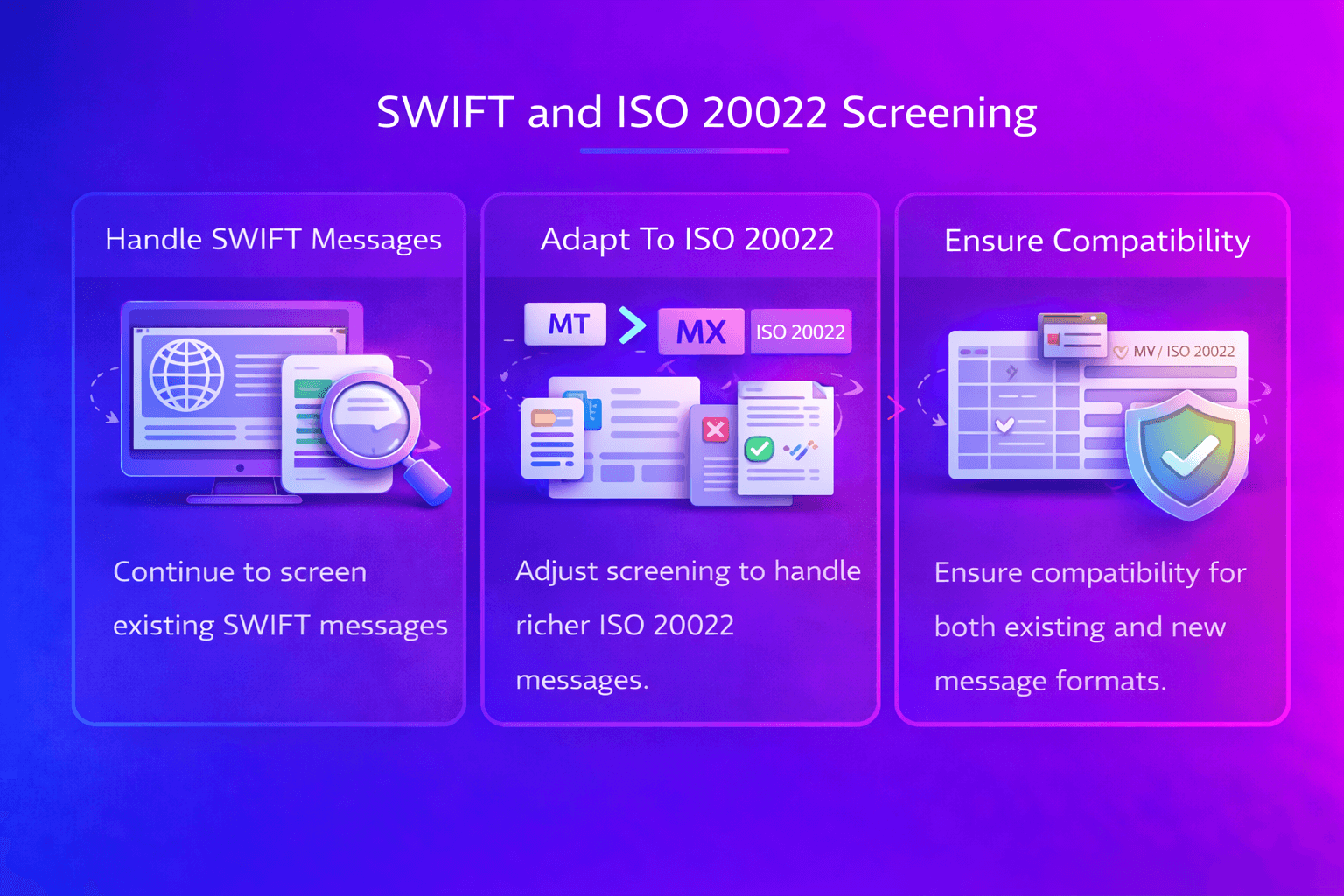
How SWIFT Payment Screening Works
SWIFT MT payment messages contain a set of predefined fields that represent different elements of a payment transaction.
Originator Field
This field identifies the party sending the payment.
Beneficiary Field
This field identifies the party receiving the payment.
Intermediary Banks
These fields identify the financial institutions involved in routing the payment through correspondent banking networks.
Free Text Fields
Narrative fields may contain additional information such as payment references.
Payment screening engines analyse these fields using systems such as payment screening platforms that compare names and other identifiers against regulatory watchlists.
However, because SWIFT MT messages often contain limited structured data, screening engines may rely heavily on name matching when evaluating potential sanctions exposure.
How ISO 20022 Improves Payment Data
ISO 20022 messages introduce a more detailed and structured data model for financial transactions.
Instead of relying on compact legacy fields, ISO 20022 messages provide multiple dedicated fields for identifying parties involved in a payment. These fields can include detailed attributes such as addresses, identification numbers, and additional contextual data.
Because ISO 20022 messages contain richer information, screening engines can evaluate more attributes when detecting potential sanctions matches.
For compliance teams, this additional data improves the ability to distinguish between genuine matches and unrelated individuals with similar names.
Where Payment Screening Fits In The Compliance Workflow
Regardless of the message format used, payment screening typically occurs before the payment is completed.
Payment Initiation
A payment message is generated and transmitted through a payment network.
Transaction Screening
The message is evaluated by payment screening platforms that compare transaction data against sanctions lists.
Alert Generation
If the screening engine identifies a potential match, the system generates an alert.
Investigation
Compliance analysts review alerts and determine whether the transaction involves a sanctioned party.
Transaction Approval Or Escalation
Payments may proceed if alerts are cleared, or they may be blocked or escalated if sanctions exposure is confirmed.
Reliable watchlist data managed through structured systems such as a watchlist management framework ensures screening engines operate on accurate sanctions information.
Operational Challenges When Screening SWIFT Messages
Although SWIFT MT messages remain widely used, their structure presents several screening challenges.
Limited Data Fields
Legacy message formats often contain fewer identifying attributes than modern messaging standards.
Unstructured Data
Free text fields may include inconsistent or incomplete information about payment parties.
Name Matching Reliance
Because of limited structured data, screening engines often rely heavily on fuzzy name matching to detect potential sanctions matches.
These limitations can increase false positive rates and investigation workloads.
Advantages Of ISO 20022 For Compliance Screening
ISO 20022 messaging provides several advantages for sanctions screening systems.
Richer Party Identification
Multiple structured fields allow screening engines to evaluate additional identifying attributes.
Better Data Standardisation
Consistent message structures allow screening engines to interpret payment data more reliably.
Improved Match Accuracy
Screening systems can combine name similarity with other identifiers such as address or identification numbers.
These improvements allow compliance teams to reduce false positives while maintaining strong detection capability.
Professional Insight And Operational Confidence
The transition from SWIFT MT messaging to ISO 20022 represents one of the most significant structural changes in global payment infrastructure. While this shift introduces operational challenges for financial institutions, it also creates opportunities to strengthen sanctions screening capabilities.
Compliance teams that adapt their screening systems to take advantage of richer ISO 20022 data will be better positioned to improve detection accuracy while reducing unnecessary alerts.
Practical Experience
Compliance practitioners often observe that richer payment data significantly improves the clarity of screening investigations.
Technical And Regulatory Expertise
Understanding payment message structures is essential for designing reliable screening controls.
Building Confidence In Controls
When payment data is structured and complete, investigators can assess alerts more confidently and demonstrate that screening decisions are based on reliable information.
People First Compliance Content
Financial crime compliance ultimately depends on investigators and analysts who interpret alerts and assess potential risks. Technology assists by identifying possible matches, but the strength of the compliance framework depends on how effectively investigators analyse available information.
Educational resources like this aim to help compliance professionals understand how payment message structures influence the effectiveness of sanctions screening systems.
Next Steps For Your Organisation
As payment infrastructures evolve toward ISO 20022 messaging, financial institutions must ensure that their screening systems can fully interpret the richer data contained within these new message formats.
If your organisation is evaluating how its payment screening controls will adapt to ISO 20022 messaging, explore how your screening architecture compares with current industry practices.