AML Compliance


Sanctions screening has become one of the most critical operational components of anti money laundering compliance. Financial institutions must ensure that customers, payments, and business relationships are not linked to sanctioned individuals, organisations, vessels, or jurisdictions. To achieve this, banks rely on screening systems that compare customer and transaction data against sanctions lists issued by global authorities.
Understanding sanctions screening statistics helps compliance leaders evaluate the scale of the operational challenge. Screening systems process extremely large volumes of names and transactions every day, often generating significant numbers of alerts that investigators must review before determining whether a genuine sanctions risk exists.
This guide summarises the most important sanctions screening statistics and explains what they reveal about the operational realities of modern financial crime compliance.
Scale Of Global Sanctions Lists
Sanctions lists maintained by governments and international organisations have grown significantly in recent years. Authorities frequently add new individuals, entities, and vessels to sanctions programmes as geopolitical developments evolve.
For example, information published through the United Nations Security Council sanctions regimes shows how international sanctions programmes expand in response to global security threats.
National authorities also maintain extensive sanctions lists. The United States Treasury publishes sanctions designations through the Office of Foreign Assets Control sanctions programmes which contain thousands of designated individuals and entities.
As sanctions programmes expand, financial institutions must continuously update their screening systems to ensure that newly designated parties are detected.
Screening Volumes Inside Financial Institutions
Large financial institutions screen enormous volumes of data every day. Customer onboarding systems evaluate new clients against sanctions lists, while payment screening engines analyse transactions before they are processed.
In major international banks, screening systems may evaluate millions of names and transactions each day. This includes both customer screening and payment screening activities.
Compliance infrastructure often integrates sanctions data through a watchlist management platform that consolidates lists from multiple authorities and distributes updates to screening systems across the organisation.
Maintaining accurate sanctions data is therefore a core operational requirement for effective screening.
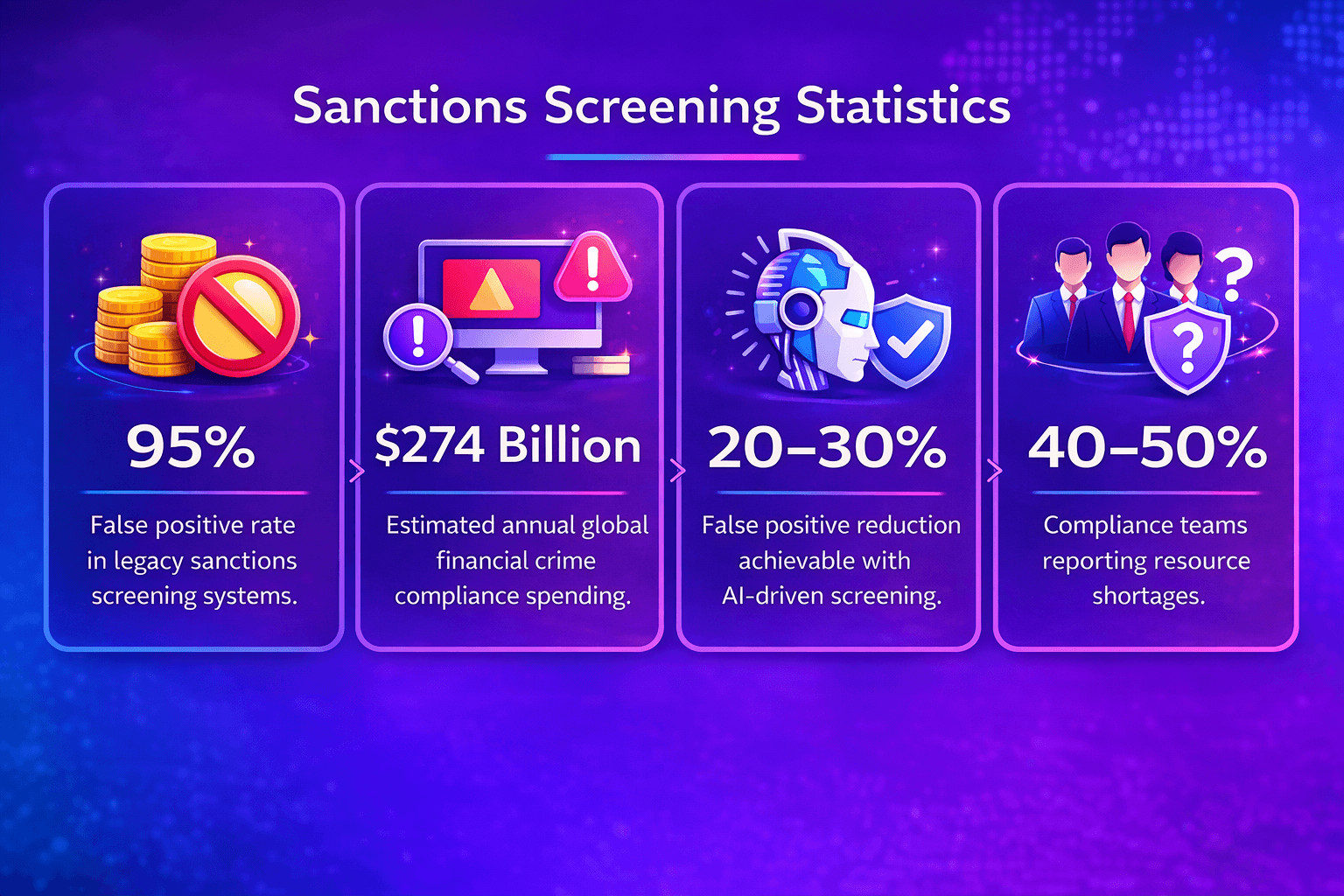
False Positive Rates In Sanctions Screening
One of the most widely discussed statistics in sanctions compliance is the rate of false positive alerts generated by screening systems. In many financial institutions, the majority of screening alerts do not represent genuine sanctions matches.
False positives often occur when legitimate customers share similar names with sanctioned individuals. Variations in spelling, transliteration differences, and incomplete identifying data can increase the likelihood of alerts.
As a result, compliance teams may review thousands of alerts in order to identify a small number of true sanctions matches.
Improving screening accuracy through advanced customer screening systems helps reduce unnecessary alerts while maintaining detection capability.
Payment Screening Alert Volumes
Payment screening systems generate particularly large numbers of alerts because every payment must be evaluated before processing. High volume payment networks such as cross border wire transfers and instant payment systems require screening engines capable of operating in real time.
When a potential match is identified, investigators must review the alert to determine whether the transaction involves a sanctioned party. Structured alert adjudication workflows allow compliance teams to analyse matches, compare identifying attributes, and document their investigation decisions.
Because of the speed of modern payment systems, these investigations must often occur extremely quickly.
Regulatory Enforcement Statistics
Regulators around the world continue to impose significant penalties on financial institutions that fail to maintain effective sanctions screening controls. Enforcement actions often arise from weaknesses in sanctions screening systems, incomplete sanctions data, or failures to investigate alerts properly.
Authorities such as the UK Office of Financial Sanctions Implementation publish guidance explaining enforcement expectations and compliance responsibilities for regulated institutions.
These enforcement actions highlight the importance of maintaining reliable sanctions data, accurate screening systems, and well documented investigation processes.
Operational Challenges Revealed By Screening Data
Statistical analysis of sanctions screening programmes reveals several common operational challenges.
High Alert Volumes
Large numbers of alerts require investigators to review significant amounts of information before determining whether a sanctions match is genuine.
Name Matching Complexity
Sanctioned individuals may appear under multiple spellings or aliases, making accurate detection more difficult.
Data Quality Issues
Incomplete customer or payment data can reduce the accuracy of screening systems.
List Update Frequency
Sanctions lists change frequently, requiring compliance systems to update sanctions data continuously.
Addressing these challenges requires both reliable technology infrastructure and well designed compliance processes.
What Effective Sanctions Screening Looks Like
Financial institutions that manage sanctions screening effectively typically demonstrate several key characteristics.
Reliable Sanctions Data
Sanctions lists from multiple authorities are consolidated and maintained accurately.
Efficient Investigation Processes
Investigators follow structured workflows when reviewing screening alerts.
Continuous Monitoring
Compliance teams monitor sanctions programme updates and ensure that screening systems remain aligned with regulatory requirements.
Strong Governance
Responsibilities for sanctions compliance are clearly defined within the organisation.
These practices help institutions maintain confidence that their sanctions screening systems operate effectively.
Professional Insight And Operational Confidence
Sanctions screening statistics highlight the operational scale of financial crime compliance. Large volumes of alerts, rapidly evolving sanctions programmes, and complex international payment systems create significant challenges for financial institutions.
Organisations that invest in reliable sanctions data, efficient screening technology, and well trained investigators are better positioned to manage these challenges while maintaining confidence in their compliance frameworks.
Practical Experience
Compliance professionals frequently observe that improvements in data quality and screening configuration significantly reduce unnecessary alerts.
Technical And Regulatory Expertise
Strong sanctions screening programmes require both regulatory knowledge and sophisticated screening infrastructure.
Building Confidence In Controls
When screening systems operate consistently and investigators document their decisions clearly, institutions can demonstrate that their sanctions controls are both reliable and defensible.
People First Compliance Content
Financial crime compliance ultimately depends on investigators who analyse screening alerts and determine whether potential matches represent genuine sanctions risks. Technology enables institutions to screen large volumes of data, but human expertise remains essential when interpreting results and documenting investigation decisions.
Educational resources such as this guide help compliance professionals understand the operational realities reflected in sanctions screening statistics.
Next Steps For Your Organisation
Sanctions programmes continue to expand and evolve as governments respond to geopolitical developments. Financial institutions must therefore ensure that their screening systems remain aligned with current sanctions lists and regulatory expectations.
If your organisation is evaluating improvements to its sanctions screening architecture, explore how your compliance framework compares with current industry practices.