AML Compliance


Fuzzy matching is a core capability in modern sanctions screening systems. Financial institutions rely on fuzzy matching algorithms to detect variations in spelling, transliteration, and phonetic representation when comparing customer or transaction data against sanctions lists.
Names often appear differently across languages, jurisdictions, and data sources. Without fuzzy matching, screening systems would miss many genuine sanctions matches simply because a name is spelled differently. At the same time, overly sensitive matching thresholds can produce extremely large volumes of alerts that investigators must review.
Tuning fuzzy matching thresholds is therefore one of the most important configuration tasks in financial crime screening. Proper calibration allows compliance teams to detect genuine matches while reducing unnecessary alerts that slow operations.
This guide explains how fuzzy matching thresholds work, how organisations tune them in practice, and how compliance teams balance detection capability with operational efficiency.
Why Fuzzy Matching Exists In Sanctions Screening
Sanctions lists contain individuals and entities from many regions and languages. Names can be represented in multiple ways depending on transliteration rules, local spelling conventions, or data entry practices.
For example, a single individual might appear as:
• Sergei Ivanovich Petrov
• Sergey Ivanovich Petrov
• Sergey Petrov
Exact matching would treat these names as different, even though they refer to the same person. Fuzzy matching algorithms address this problem by identifying similarities between strings rather than requiring exact matches.
These algorithms evaluate factors such as:
• Phonetic similarity
• Character distance
• Token order
• Partial matches
Because sanctions screening systems rely heavily on name comparison, fuzzy matching becomes the primary mechanism for detecting potential matches.
However, the flexibility that enables detection also introduces noise. If thresholds are too permissive, the system may generate alerts for individuals who merely have similar names.
How Fuzzy Matching Thresholds Work
Fuzzy matching algorithms typically calculate a similarity score between two strings. This score represents how closely the screened name resembles the watchlist name.
For example:
• Exact match: 100 percent similarity
• Minor spelling variation: 90 percent similarity
• Partial name similarity: 70 percent similarity
Screening systems generate alerts when the similarity score exceeds a configured threshold.
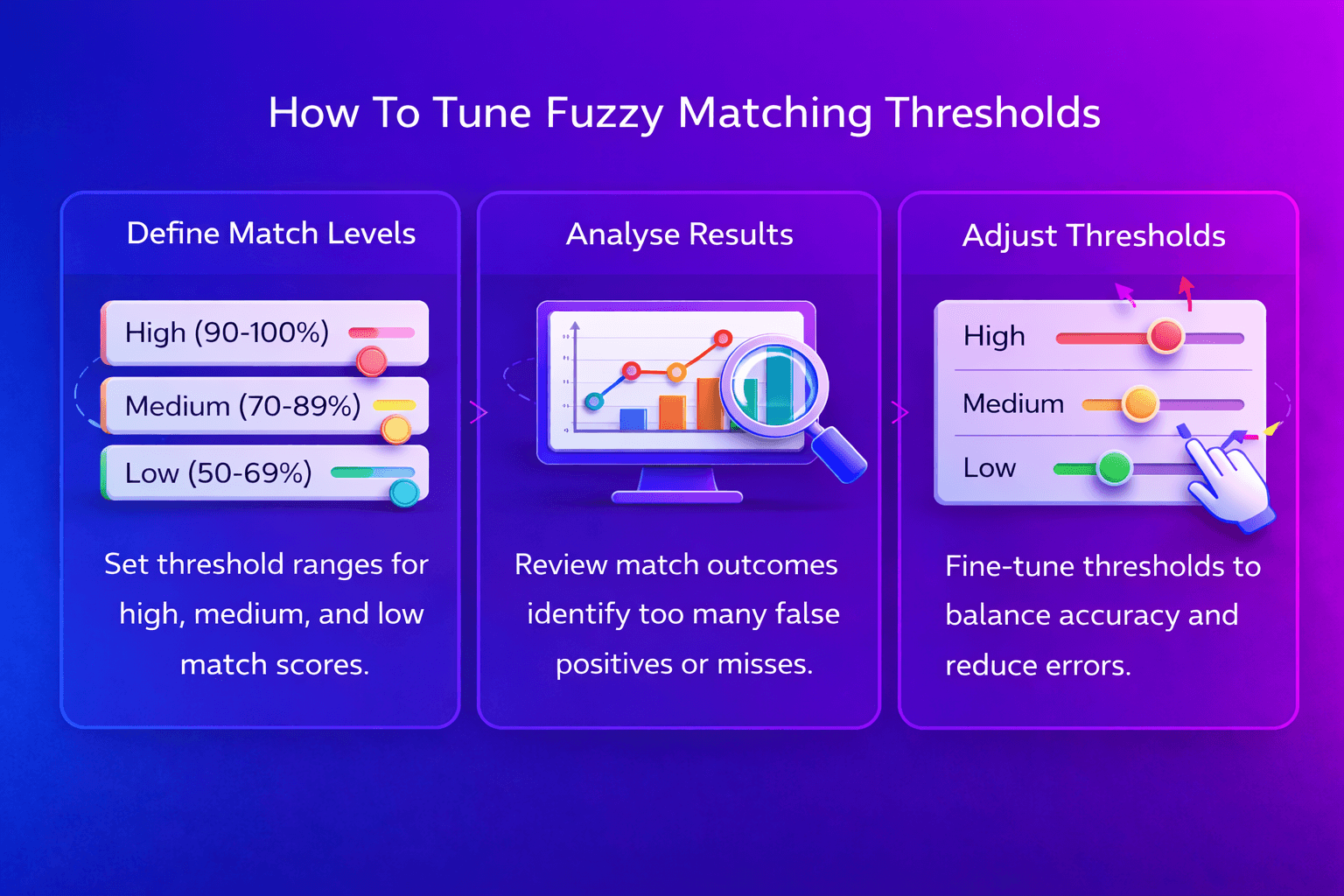
If the threshold is set at 85 percent, the system will trigger alerts for matches above that score. If the threshold is lowered to 70 percent, many more alerts may be generated because weaker similarities are now considered potential matches.
This configuration decision directly affects alert volumes and investigation workload.
Where Fuzzy Matching Fits In The Screening Pipeline
Fuzzy matching operates within the broader sanctions screening workflow.
First, sanctions data is collected and standardised through structured list governance processes such as a watchlist management framework that consolidates sanctions sources and prepares them for screening.
Next, screening engines compare customer or transaction attributes against the watchlist data. Systems such as customer screening platforms evaluate names using fuzzy matching logic combined with other identifying attributes.
If the similarity score exceeds the configured threshold, the system generates an alert.
Investigators then review the alert using structured alert adjudication workflows that allow analysts to compare additional attributes and determine whether the match is genuine.
Understanding this pipeline helps compliance teams tune thresholds effectively because configuration changes affect the entire detection workflow.
The Trade-Off Between Detection And Alert Volume
Tuning fuzzy matching thresholds requires balancing two competing objectives.
Detection Sensitivity
Lower thresholds allow the system to detect weaker similarities. This increases the likelihood of identifying genuine sanctions matches, especially when names appear with significant spelling variation.
Operational Efficiency
Higher thresholds reduce the number of alerts generated by the system. This allows investigators to focus on higher quality alerts rather than reviewing large volumes of weak matches.
Compliance teams must therefore calibrate thresholds in a way that maintains detection capability while keeping investigation workloads manageable.
Key Factors That Influence Threshold Calibration
Several operational factors influence how organisations tune fuzzy matching thresholds.
Customer Demographics
Certain regions have naming conventions that generate higher similarity across large populations. Institutions with customers in these regions may need slightly higher thresholds to avoid excessive alert volumes.
Data Quality
If customer records contain incomplete or inconsistent identifying attributes, screening systems rely more heavily on name matching. This may require lower thresholds to maintain detection capability.
Improving data quality often allows institutions to increase thresholds without weakening controls.
Watchlist Data Structure
Well structured sanctions lists with additional identifiers allow screening engines to evaluate multiple attributes rather than relying solely on name similarity.
This enables more precise matching decisions.
Regulatory Expectations
Institutions must ensure that threshold calibration does not reduce the effectiveness of sanctions detection. Regulators expect organisations to demonstrate that screening configuration reflects their risk exposure.
Practical Methods For Tuning Matching Thresholds
Organisations typically calibrate fuzzy matching thresholds through a structured testing process.
Historical Alert Analysis
Compliance teams analyse historical alerts to determine which similarity scores typically produce genuine matches versus false positives.
This data helps identify threshold ranges that maximise detection accuracy.
Scenario Testing
Testing scenarios can simulate how the screening engine behaves when thresholds are adjusted. By running sample datasets through different configurations, teams can observe how alert volumes change.
Alias Testing
Testing should include variations of names, aliases, and transliteration patterns to ensure genuine matches are still detected.
Segment Based Calibration
Some organisations apply different thresholds across customer segments or business lines based on risk exposure.
Segment based calibration allows screening systems to remain sensitive where risk is higher while reducing unnecessary alerts in lower risk areas.
Common Mistakes In Threshold Configuration
Many institutions encounter similar problems when configuring fuzzy matching thresholds.
Static Thresholds
Thresholds that are never reviewed may gradually become ineffective as customer bases and sanctions lists evolve.
Overly Aggressive Matching
Very low thresholds can produce large volumes of alerts that overwhelm investigators without improving detection capability.
Lack Of Testing
Adjusting thresholds without testing different scenarios can introduce detection gaps or operational disruption.
Ignoring Investigator Feedback
Investigators reviewing alerts often identify patterns in false positives. Ignoring this feedback can prevent organisations from improving threshold configuration.
What Effective Threshold Calibration Looks Like
Organisations that successfully tune fuzzy matching thresholds typically adopt structured calibration processes.
Continuous Performance Monitoring
Alert metrics such as false positive rates, investigation times, and escalation outcomes should be monitored regularly.
Data Driven Configuration
Threshold adjustments should be based on empirical data rather than assumptions about how the screening system behaves.
Collaboration Between Teams
Compliance analysts, data scientists, and screening system administrators should work together when adjusting matching logic.
Periodic Reviews
Screening configuration should be reviewed periodically to ensure thresholds remain aligned with the institution's risk environment.
Professional Insight And Operational Confidence
Calibrating fuzzy matching thresholds is an ongoing process rather than a one time configuration task. Screening environments evolve continuously as sanctions lists expand, customer populations change, and new data sources are introduced. Compliance teams that monitor alert patterns and test threshold adjustments regularly can maintain strong detection capability while preventing investigation workloads from becoming unmanageable.
Practical Experience
Experienced compliance practitioners understand that fuzzy matching calibration is not a one time task. Screening environments evolve constantly as customer bases grow and sanctions lists expand.
Technical And Regulatory Expertise
Effective threshold tuning requires both technical understanding of matching algorithms and regulatory awareness of sanctions obligations.
Building Confidence In Controls
When thresholds are tuned carefully and monitored regularly, organisations gain confidence that screening systems are detecting genuine risk while maintaining operational efficiency.
People First Compliance Content
Financial crime compliance ultimately depends on the expertise of analysts and investigators who interpret screening alerts and apply professional judgement.
Technology can assist in detecting potential matches, but the effectiveness of sanctions screening depends on how well systems are configured and how consistently investigators apply investigation procedures.
Educational resources like this aim to support compliance professionals by explaining how screening systems operate and how configuration decisions affect real world compliance operations.
Next Steps For Your Organisation
Tuning fuzzy matching thresholds can significantly improve sanctions screening performance when approached systematically.
Many organisations find that reviewing historical alert data and testing threshold scenarios reveals opportunities to reduce false positives without weakening detection capability.
If your organisation is evaluating how to optimise its screening configuration, explore how your screening architecture compares with current industry practices.