Sanctions Screening


Sanctions screening is one of the most important operational controls in financial crime compliance. Every bank, fintech, payment institution, and financial services provider must ensure that customers, counterparties, and transactions are not connected to sanctioned individuals or entities.
However, the reality inside most compliance operations is that sanctions screening produces an overwhelming number of alerts. The majority of these alerts turn out to be false positives, meaning the screened person or transaction only appears similar to a sanctioned entity but is not actually the same individual.
For compliance teams, this creates a serious operational challenge. Analysts spend large amounts of time investigating alerts that ultimately present no real risk. Customer onboarding can slow down, payment processing can be delayed, and operational costs increase as teams scale to manage alert volumes.
Reducing false positives therefore becomes a key objective for compliance leaders. The goal is not to weaken screening controls, but to improve how screening systems operate so that alerts are more accurate, investigations are faster, and genuine risk is easier to identify.
This guide explains why sanctions screening produces so many false positives, where they originate within screening systems, and how organisations can improve their processes, data, and technology to reduce unnecessary alerts while maintaining strong regulatory controls.
Why False Positives Are So Common In Sanctions Screening
Sanctions lists published by governments and international bodies contain individuals and entities subject to financial restrictions. These lists are maintained by authorities such as the United Nations, the European Union, the United States Office of Foreign Assets Control, and the United Kingdom government.
The challenge is that sanctions lists often contain limited identifying information. A typical record may only include:
• Full name
• Known aliases
• Partial date of birth
• Nationality
• Sometimes an address or passport number
Because of these limitations, screening systems must rely heavily on name matching algorithms to detect potential matches.
Regulators expect institutions to implement effective sanctions controls. For example, guidance published by the UK government through the Office of Financial Sanctions Implementation explains the responsibilities of regulated institutions when applying financial sanctions controls, including maintaining effective screening procedures and investigation processes.
Institutions therefore configure screening systems to be sensitive enough to detect potential matches, even when spelling differences or transliteration variations exist.
This necessary sensitivity is what creates false positives.
A screening system may detect a similarity between two names such as:
• Sergei Ivanovich Petrov
• Sergey Ivanovich Petrov
• Sergey Petrov
Even though the individuals are unrelated, the system generates an alert because the similarity threshold has been exceeded.
Across large customer bases and payment volumes, this can lead to thousands or even millions of alerts per year.
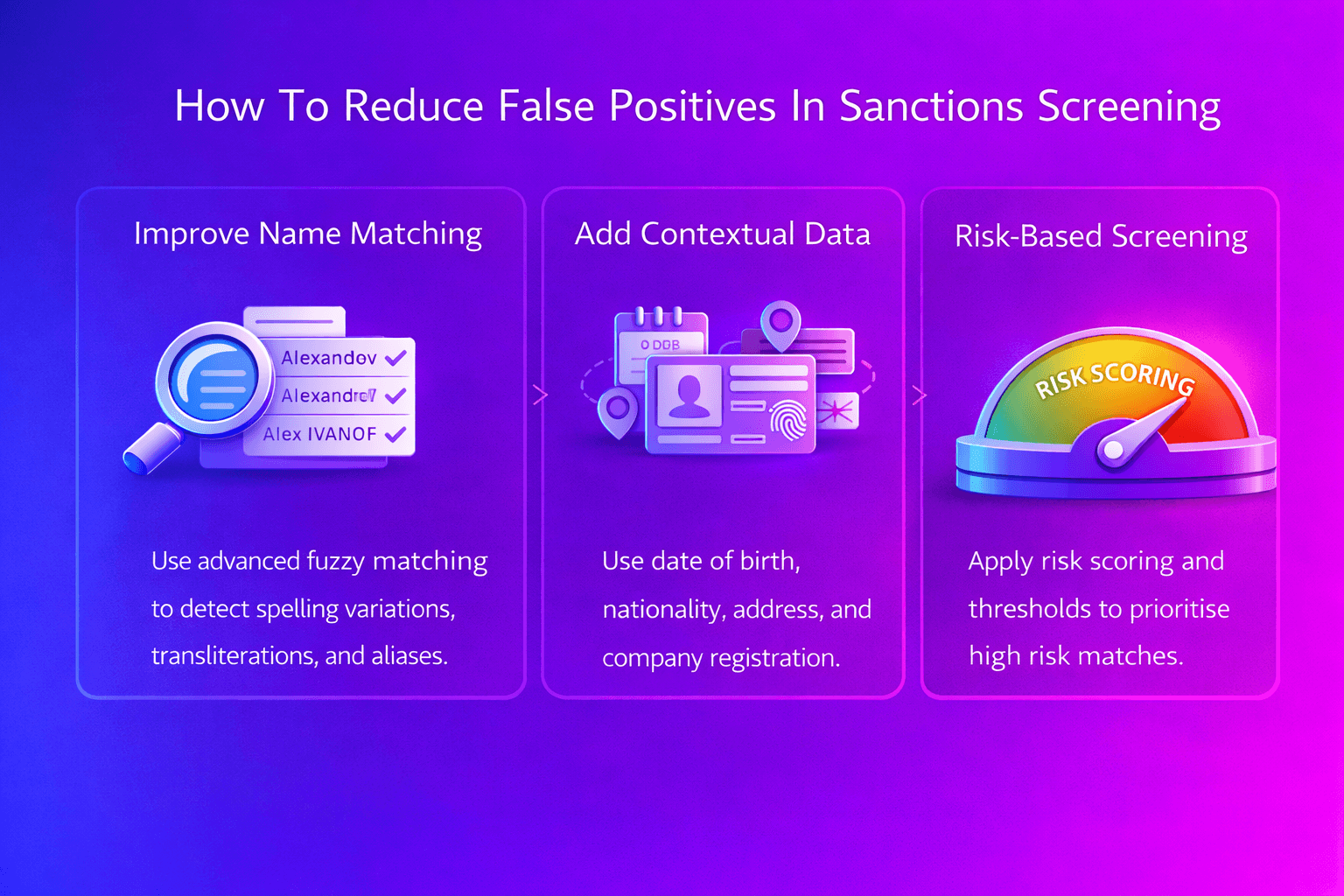
Where False Positives Actually Originate
False positives rarely originate from a single problem. Instead, they emerge from multiple parts of the sanctions screening ecosystem.
Understanding where they come from is the first step toward reducing them.
Poorly Structured Watchlist Data
Sanctions screening systems depend on high quality watchlist data. However, sanctions lists are published by many different authorities using different formats and data standards.
Without proper data normalisation, the same sanctioned individual may appear multiple times across lists with slightly different spellings or formats.
Centralised list management is therefore critical. Many organisations reduce alert volumes by improving how sanctions data is ingested, standardised, and deduplicated through structured list management environments such as a dedicated watchlist management platform that consolidates multiple sanctions feeds into a single governed repository.
When watchlists are standardised and enriched before screening occurs, screening engines can apply more precise matching logic.
Incomplete Customer Data
Internal customer data is often just as problematic as sanctions list data.
Many financial institutions still hold customer records with missing or inconsistent attributes such as:
• Abbreviated names
• Missing middle names
• Inconsistent date formats
• Incomplete addresses
When a screening system lacks reliable identifiers, it must rely primarily on name matching, which increases the likelihood of false positives.
Improving data quality during onboarding and throughout the customer lifecycle can significantly reduce unnecessary alerts.
Overly Conservative Matching Thresholds
Many compliance teams configure screening engines to prioritise detection over efficiency. This often results in very low match thresholds that trigger alerts even when similarities are weak.
While this approach may appear safer, it can produce enormous volumes of low quality alerts that distract investigators from genuine risk.
Calibrating matching thresholds based on risk exposure, customer types, and geographic factors can dramatically improve alert quality.
Duplicate Watchlist Entries
Duplicate records across sanctions lists can also produce multiple alerts for the same potential match. Without proper deduplication processes, screening engines may generate separate alerts for each instance of the same individual across different list sources.
Effective list governance removes these duplicates before screening takes place.
How Sanctions Screening Systems Actually Work
To understand how false positives can be reduced, it helps to understand the operational workflow behind sanctions screening.
Most screening systems follow a multi stage process.
Screening Event
Screening is triggered when a relevant event occurs, such as:
• A new customer onboarding
• A payment transaction
• A periodic rescreening cycle
The system compares customer or transaction attributes against sanctions list records.
Matching Engine Evaluation
The matching engine evaluates similarities between attributes such as:
• Names
• Dates of birth
• Nationalities
• Addresses
• Identification numbers
Fuzzy matching algorithms allow the system to detect variations in spelling, phonetics, or transliteration.
Alert Generation
If the calculated similarity score exceeds the configured threshold, the system generates an alert for investigation.
At this stage, the system does not confirm whether the match is real. It simply indicates that further review is required.
Alert Investigation
Compliance analysts review the alert by comparing available data between the customer and the sanctioned entity. Analysts examine additional attributes to determine whether the individuals are actually the same.
This investigation stage is where most false positives are cleared.
Many institutions streamline this stage using structured investigation environments such as alert adjudication systems that allow analysts to manage cases, apply consistent investigation procedures, and record audit evidence.
The Operational Impact Of High False Positive Rates
When sanctions screening systems produce excessive alerts, the impact on compliance operations can be significant.
Investigation Backlogs
Large volumes of alerts can quickly overwhelm investigation teams. Analysts must work through queues of cases that may contain very little real risk.
Slower Customer Onboarding
False positives during customer screening can delay onboarding processes, particularly when alerts require manual investigation before accounts can be activated.
Payment Processing Delays
Payment screening alerts can delay legitimate transactions while compliance teams verify that the payment does not involve a sanctioned entity.
Investigator Fatigue
When analysts repeatedly review low quality alerts, fatigue can reduce investigation quality and increase the risk of errors.
Reducing false positives therefore improves both operational efficiency and compliance effectiveness.
What Effective Sanctions Screening Looks Like
Organisations that successfully reduce false positives typically adopt a more structured and integrated approach to sanctions screening.
Structured List Governance
Effective screening begins with properly governed sanctions lists. Lists should be:
• Automatically ingested from authoritative sources
• Normalised into consistent formats
• Deduplicated across jurisdictions
• Enriched with additional attributes where available
These improvements allow screening engines to operate on high quality reference data.
Risk Based Matching Configuration
Matching algorithms should be calibrated according to risk exposure rather than configured using static global thresholds.
For example, higher risk jurisdictions may require more sensitive matching thresholds, while lower risk segments can tolerate stricter filtering.
The Financial Action Task Force emphasises the importance of proportionate controls through its risk based approach for the banking sector, which encourages financial institutions to design AML and sanctions controls that reflect their actual risk exposure.
Applying a risk based approach to screening configuration can significantly reduce unnecessary alerts.
Data Enrichment And Contextual Matching
Advanced screening environments incorporate additional data sources to improve identification accuracy. Additional identifiers such as passport numbers, corporate registration numbers, or structured addresses can dramatically reduce ambiguity during screening.
Continuous Monitoring And Calibration
Screening performance should be monitored regularly.
Compliance teams should analyse metrics such as:
• False positive rates
• Investigation resolution times
• Alert volumes by business line
These insights help teams recalibrate thresholds and rules as risk environments evolve.
How Organisations Typically Reduce False Positives
Improving sanctions screening rarely requires replacing an entire system. Instead, organisations typically implement a series of targeted improvements.
Step One: Assess Current Alert Patterns
Compliance teams begin by analysing existing screening results. They identify which lists, customer segments, or jurisdictions generate the highest volumes of false positives.
Understanding these patterns helps prioritise improvements.
Step Two: Improve Data Quality And List Management
The next step focuses on improving the quality of both sanctions data and internal customer data. This often includes data cleansing projects, improved onboarding data capture, and better watchlist governance.
Even modest improvements in data quality can significantly improve screening accuracy.
Step Three: Optimise Matching Logic
Screening algorithms should be tuned based on real operational results. Adjusting phonetic matching rules, alias handling, and similarity thresholds can greatly reduce irrelevant alerts.
Step Four: Strengthen Investigation Workflows
Finally, organisations improve how alerts are investigated. Structured case management, consistent investigation procedures, and automation tools help analysts resolve alerts faster.
A short internal benchmarking exercise can often reveal areas where screening performance can improve without weakening controls.
Professional Insight And Operational Confidence
Reducing false positives in sanctions screening requires more than simply adjusting screening thresholds. In practice, effective programmes combine high quality watchlist data, calibrated matching logic, and well structured investigation workflows. Compliance teams that regularly review alert outcomes and investigator feedback are better positioned to balance detection sensitivity with operational efficiency while maintaining strong regulatory defensibility.
Practical Experience
Compliance practitioners know that sanctions screening rarely fails because of a single issue. Most operational problems emerge from a combination of poor data, outdated list management, and inefficient workflows.
Improving the entire screening ecosystem produces far better results than focusing on a single component.
Technical And Regulatory Expertise
Effective screening requires understanding both regulatory expectations and technological limitations. Institutions must maintain robust detection capabilities while ensuring systems remain operationally manageable.
Balancing these factors requires careful calibration and continuous monitoring.
Building Confidence In Controls
When screening systems produce manageable alert volumes and consistent investigation outcomes, compliance teams gain confidence in their financial crime controls.
This confidence becomes especially important during regulatory reviews and independent audits.
People First Compliance Content
Compliance technology is important, but financial crime prevention ultimately depends on the expertise and judgement of compliance professionals.
Analysts, investigators, and risk leaders apply regulatory knowledge, contextual understanding, and professional judgement every day when reviewing alerts and managing risk.
Content like this is designed to support those professionals by explaining the operational realities behind compliance controls and highlighting practical improvements that organisations can implement.
Next Steps For Your Organisation
Many institutions find that sanctions screening performance can improve significantly through targeted changes to data quality, list governance, and alert investigation workflows.
A structured review of your current screening configuration can often reveal opportunities to reduce false positives while strengthening overall compliance controls.
If your organisation is evaluating how to improve screening accuracy or streamline investigation workflows, the compliance specialists at Facctum can help you assess your current approach. Explore how your screening architecture compares with current industry practices.
Even small adjustments to screening configuration, data quality, or investigation processes can lead to meaningful improvements in operational efficiency.