Sanctions Screening


Sanctions screening systems are a core control in financial crime compliance. Banks, fintech firms, payment providers, and other regulated institutions rely on these systems to detect potential matches with sanctioned individuals, entities, or jurisdictions.
However, simply implementing a screening system is not enough. Regulators expect organisations to demonstrate that the system operates effectively, that alerts are investigated properly, and that controls are calibrated to the institution’s risk exposure. Auditing a sanctions screening system is therefore essential to ensure the control is functioning as intended.
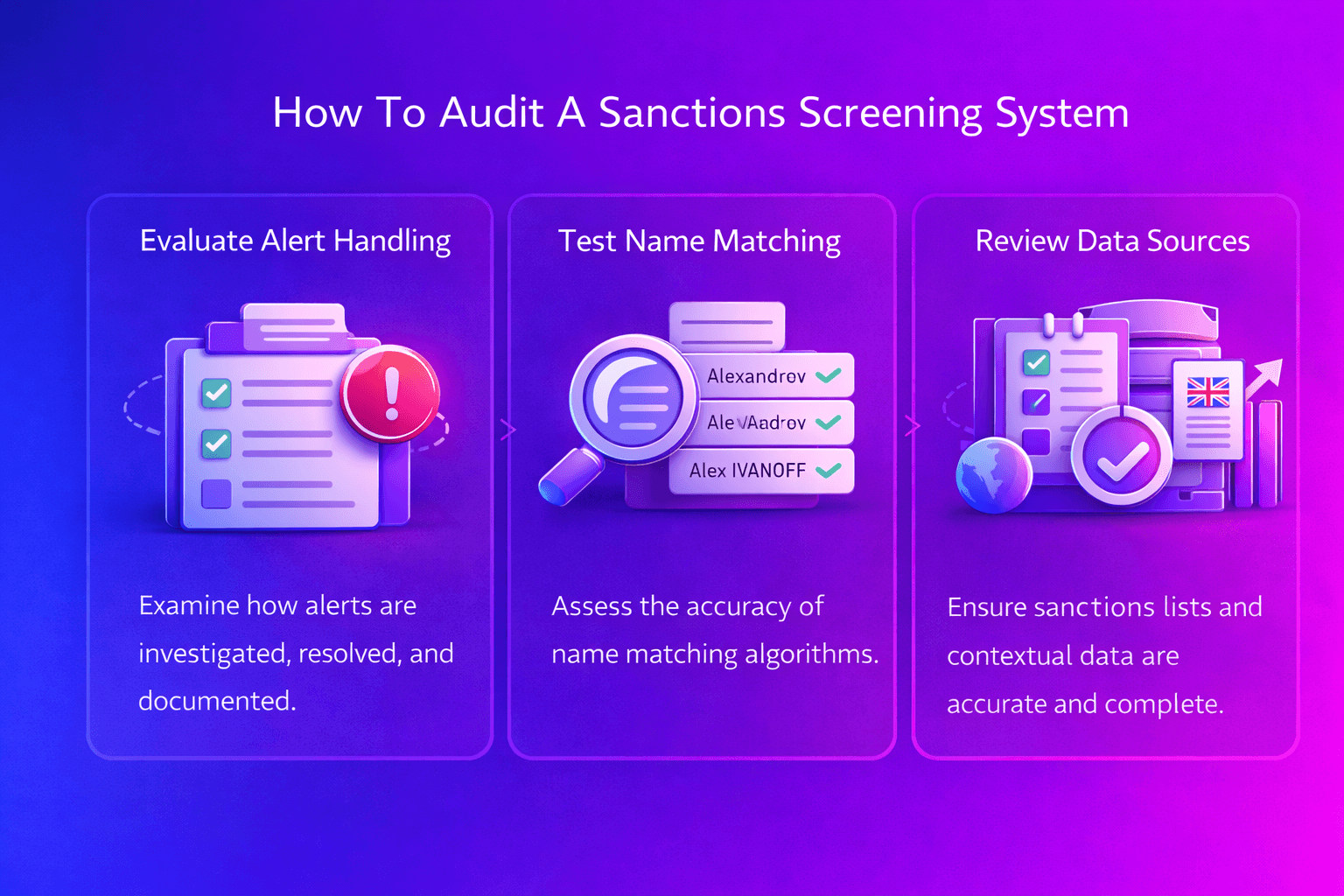
A well structured audit examines how screening lists are managed, how matching logic is configured, how alerts are investigated, and whether decisions are documented in a defensible way. The goal is not only to confirm compliance with regulatory expectations but also to identify weaknesses that may reduce detection capability or create unnecessary operational burden.
This guide explains how compliance teams and internal auditors assess sanctions screening systems in practice, what components should be examined during an audit, and how organisations can strengthen the defensibility of their screening controls.
Why Sanctions Screening Audits Are Important
Financial institutions must demonstrate that sanctions controls are reliable and consistently applied. Regulators increasingly examine not only whether a screening system exists but also whether it is operating effectively.
International regulatory guidance emphasises the importance of risk based controls. The Financial Action Task Force highlights this expectation through its guidance on the risk based approach for the banking sector, which explains how financial institutions should design financial crime controls proportionate to their risk exposure.
Without regular auditing, screening systems may gradually drift away from their intended configuration. Watchlists may become outdated, thresholds may no longer reflect operational realities, and investigation procedures may become inconsistent.
A structured audit helps organisations answer critical questions such as:
• Are sanctions lists complete and up to date?
• Are screening rules calibrated correctly?
• Are investigators clearing alerts consistently?
• Are audit trails sufficient for regulatory review?
Regular audits provide assurance that sanctions controls remain effective over time.
Core Components Of A Sanctions Screening System
Before conducting an audit, it is important to understand the architecture of a typical screening system. Most sanctions screening frameworks consist of several interconnected components.
Watchlist Governance
Sanctions lists originate from multiple authorities including national regulators and international bodies. These lists must be ingested, normalised, and maintained before screening occurs.
Many institutions centralise this process through a structured watchlist management framework that consolidates sanctions feeds, removes duplicate entries, and standardises list data for screening engines.
Strong list governance ensures the screening system operates on accurate and up to date reference data.
Screening Engine
The screening engine compares customer or transaction attributes against watchlist records. Modern systems use fuzzy matching algorithms to detect similarities in spelling, phonetics, or transliteration.
For example, screening engines used in payment screening systems evaluate attributes such as names, account details, and payment references to identify potential sanctions matches.
Matching configuration plays a critical role in determining how sensitive the system is when generating alerts.
Alert Investigation
When the screening engine detects a potential match, an alert is generated. Investigators must then determine whether the alert represents a genuine sanctions exposure or a false positive.
Structured investigation environments such as alert adjudication workflows help investigators review alerts, document investigative reasoning, and maintain a clear audit trail.
Each of these components should be examined during a sanctions screening audit.
Key Areas To Review During A Screening Audit
Auditing a sanctions screening system typically involves reviewing several operational and technical components.
List Data Integrity
Auditors should verify that sanctions lists are sourced from authoritative providers and updated regularly. They should confirm that the system includes relevant regulatory lists and that updates are applied without delay.
List data should also be reviewed for duplicate records or inconsistent formatting that could affect matching results.
Matching Configuration
Matching thresholds determine when alerts are triggered. Auditors should review how thresholds are configured and whether they reflect the institution’s risk profile.
Overly strict thresholds may generate excessive alerts, while overly restrictive rules may cause genuine matches to be missed.
Testing different matching scenarios helps determine whether the system behaves as expected.
Alert Investigation Procedures
Investigators should follow clearly defined procedures when reviewing alerts. Auditors should verify that investigators consistently examine identifying attributes such as names, dates of birth, addresses, and aliases.
The audit should also confirm that investigators document the reasoning behind each decision.
Escalation And Reporting Controls
When investigators identify a potential sanctions match, escalation procedures must be followed. Auditors should verify that escalation pathways are clearly defined and that suspicious cases are reported appropriately.
Testing Screening System Performance
Beyond reviewing configuration and procedures, auditors often perform testing to evaluate screening performance.
Sample Alert Reviews
Auditors may review a sample of cleared alerts to confirm that investigators followed defined procedures and documented their reasoning appropriately.
Synthetic Test Scenarios
Testing may include inserting known sanctioned entities into test datasets to verify whether the screening system detects them correctly.
Threshold Sensitivity Testing
Auditors may also test different matching thresholds to determine whether alert generation behaves as expected.
These testing methods provide evidence that the screening system is operating effectively.
Common Weaknesses Found During Screening Audits
Sanctions screening audits frequently reveal similar operational weaknesses.
Outdated Watchlists
If list updates are not applied consistently, screening engines may miss newly sanctioned entities.
Poor Data Quality
Incomplete customer data can reduce screening accuracy and increase false positives.
Inconsistent Investigation Practices
If investigators follow different procedures when reviewing alerts, investigation outcomes may become inconsistent.
Weak Documentation
Poor documentation of investigation decisions can create regulatory risk because institutions may be unable to explain how decisions were reached.
Recognising these weaknesses allows organisations to strengthen their screening controls.
What A Strong Sanctions Screening Control Environment Looks Like
Organisations with mature screening programmes typically demonstrate several key characteristics.
Strong Data Governance
Watchlists are maintained centrally and updated regularly using automated processes.
Calibrated Matching Logic
Screening thresholds are adjusted based on risk exposure and reviewed periodically to maintain effectiveness.
Structured Investigation Workflows
Investigators follow defined procedures and document evidence supporting their decisions.
Continuous Monitoring
Screening performance metrics are reviewed regularly to ensure that alert volumes and detection capability remain balanced.
These practices help organisations maintain confidence that their screening systems are functioning correctly.
Professional Insight And Operational Confidence
Auditing sanctions screening systems requires both technical understanding and practical compliance experience. Effective reviews examine not only system configuration but also data governance, investigation procedures, and escalation controls. By evaluating the entire screening environment rather than a single component, organisations gain greater confidence that their sanctions controls remain reliable and aligned with regulatory expectations.
Practical Experience
Experienced compliance professionals understand that sanctions screening effectiveness depends on the entire screening ecosystem rather than the screening engine alone.
Data quality, list governance, investigation procedures, and escalation processes all contribute to the strength of the control.
Technical And Regulatory Expertise
Auditing screening systems requires both technical knowledge of screening algorithms and regulatory understanding of financial crime controls.
Combining these perspectives allows auditors to evaluate whether systems are both technically sound and compliant with regulatory expectations.
Building Confidence In Controls
When audits confirm that sanctions screening systems operate effectively, organisations gain confidence that their financial crime controls will withstand regulatory scrutiny.
People First Compliance Content
Financial crime compliance ultimately depends on the expertise of investigators, analysts, and risk professionals who review alerts and interpret evidence.
Technology can assist by identifying potential matches, but the strength of the compliance framework depends on how well those alerts are investigated and documented.
Educational resources like this aim to support compliance professionals by explaining operational challenges and practical approaches to strengthening financial crime controls.
Next Steps For Your Organisation
Auditing a sanctions screening system is an important step in ensuring that financial crime controls remain effective and defensible.
Many organisations discover during internal reviews that small adjustments to list management, screening thresholds, or investigation workflows can significantly improve both detection capability and operational efficiency.
If your organisation is evaluating the effectiveness of its sanctions screening controls, explore how your screening framework compares with current industry practices.