AML Compliance

Geopolitical conflict rarely stays confined to military or diplomatic arenas. When tensions escalate between states, the consequences quickly ripple through financial markets, regulatory frameworks, and global trade systems.
Recent escalation involving Iran has renewed focus on sanctions enforcement and financial crime risk across the global banking system. Financial supervisors and market participants have indicated that the conflict could increase risks for banks, inflation, and wider financial markets, as reflected in Reuters reporting on European Central Bank concerns about bank exposure to the Iran war and a separate Reuters analysis of how an oil shock can amplify financial stress.
For compliance teams this environment introduces operational challenges. Sanctions lists can change rapidly, regulators may introduce new restrictions, and illicit financial networks may attempt to move funds through complex intermediaries.
The key question for financial institutions is no longer simply whether sanctions screening exists. Instead, organizations must ensure their compliance infrastructure can adapt quickly when geopolitical developments reshape financial crime risk.
This article explores how conflict linked to Iran can affect sanctions exposure and what compliance teams should do to strengthen screening, monitoring, and operational resilience.
Latest Developments And Why Compliance Teams Should Monitor Them
Geopolitical conflicts evolve quickly, and sanctions exposure can change within days as governments respond with new regulatory measures. Compliance teams therefore need to monitor reliable news sources, regulatory announcements, and market developments continuously.
For example, financial regulators and central bank supervisors have already warned that escalation involving Iran could increase risks for European banks and global financial markets, according to reporting in a recent Reuters analysis of European Central Bank supervision concerns.
These developments matter because geopolitical shocks can rapidly affect energy prices, international trade routes, and financial market volatility. When this happens, sanctions exposure and illicit finance risks can increase at the same time.
For compliance teams, the practical implication is clear. Monitoring geopolitical developments is no longer just a responsibility for macro risk teams. It is an essential component of modern sanctions compliance and financial crime prevention.
Why Geopolitical Conflict Immediately Impacts Financial Compliance
Financial crime risk often increases when geopolitical tensions escalate. Conflict conditions create economic pressure, political instability, and regulatory intervention that reshape the financial environment.
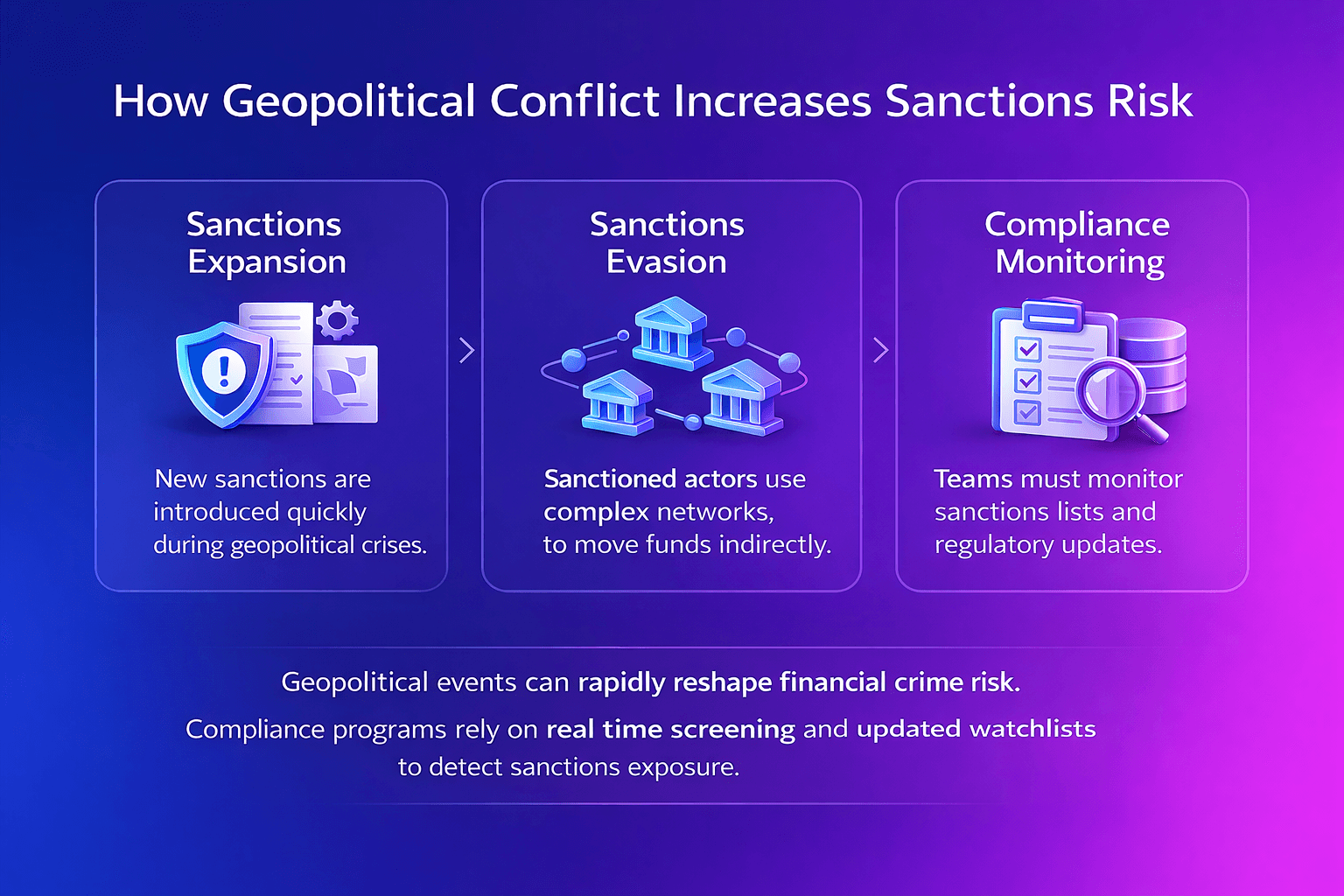
Three primary forces drive these changes.
Sanctions Expansion
Governments frequently introduce or expand sanctions regimes during geopolitical crises.
Sanctions may target individuals, state owned enterprises, banks, shipping companies, or strategic industries such as energy and technology.
Iran remains under heightened international financial scrutiny. In its 13 February 2026 statement on high risk jurisdictions subject to a call for action, the Financial Action Task Force kept Iran in the high risk category, and on its dedicated Iran country page it says members should apply enhanced due diligence and, in the most serious cases, countermeasures.
For compliance teams, the implication is clear. Geopolitical conflict can accelerate regulatory action and may expand sanctions exposure with little advance notice.
Sanctions Evasion Activity
Sanctioned entities rarely operate directly through traditional banking relationships. Instead they rely on intermediary companies, shipping networks, or trade partners to move funds indirectly.
Sanctions evasion frequently relies on layered corporate structures, maritime networks, and cross border intermediaries that obscure beneficial ownership relationships. That risk is especially relevant in the Iran context. The U.S. Treasury's Iran sanctions programme page sets out the current framework, and Treasury said on 25 February 2026 in its announcement on Iran's shadow fleet and supply networks that OFAC had sanctioned more than 875 persons, vessels, and aircraft in 2025 as part of that campaign.
These networks can make detection difficult for compliance systems that rely primarily on simple name matching.
Increased Regulatory Scrutiny
Regulators typically increase enforcement activity when geopolitical tensions affect financial markets.
Financial institutions operating internationally may face additional expectations around customer due diligence, beneficial ownership transparency, and transaction monitoring when geopolitical conflict increases sanctions exposure.
Key Financial Crime Risks Emerging From The Iran Conflict
Compliance teams monitoring geopolitical developments should pay particular attention to several categories of financial crime risk.
Sanctions Evasion Through Complex Ownership Structures
Sanctioned organizations rarely transact directly with global banks. Instead they operate through multi layered corporate structures designed to obscure ownership and control.
These networks may include shell companies, offshore holding structures, logistics intermediaries, and commodity trading firms.
Without effective beneficial ownership analysis these relationships may remain difficult to detect within financial systems.
Trade Based Money Laundering
Trade networks are a common mechanism used to bypass sanctions.
Trade based money laundering typically involves manipulating international trade documentation to disguise illicit financial flows. This can involve falsified invoices, commodity mispricing, circular shipping routes, or layered intermediaries.
Global authorities studying financial crime note that trade based laundering is a persistent risk in cross border commerce. The issue is discussed extensively within the United Nations Office on Drugs and Crime material on money laundering and international trade. It is also relevant to country and sector exposure analysis. The BIS explains in its review of bank exposures and country risk how international banking statistics can help reveal how wars, sovereign stress, and sanctions events affect financial exposures.
Cryptocurrency Based Sanctions Evasion
Digital assets have also become part of sanctions evasion infrastructure.
Cryptocurrency transfers allow rapid cross border transactions that may bypass traditional financial controls if institutions lack appropriate monitoring tools. While blockchain transactions are transparent, identifying sanctioned actors often requires advanced analytics and transaction monitoring capabilities.
Front Companies And Proxy Organizations
Sanctioned actors frequently rely on front companies that appear to be legitimate businesses operating in sectors such as shipping, oil trading, construction, and logistics.
Without effective screening and monitoring processes these proxy organizations can access the global financial system indirectly.
How Sanctions Against Iran Are Structured Across Different Jurisdictions
Sanctions compliance becomes significantly more complex when geopolitical conflict triggers restrictions across multiple regulatory jurisdictions.
Financial institutions rarely operate under a single sanctions regime. Instead they must comply with overlapping frameworks issued by regulators and international bodies.
The most influential sanctions regimes affecting Iran include measures issued by the United States Treasury through its Office of Foreign Assets Control, sanctions implemented by the European Union, UK financial sanctions rules, and global financial crime guidance from the Financial Action Task Force.
Each regime has its own enforcement mechanisms, reporting expectations, and screening requirements. For example, the official OFAC Iran sanctions page continues to publish programme guidance and recent actions, while the Council of the European Union states on its Iran sanctions policy page that some EU restrictive measures were last extended until 13 April 2026 and others until 27 July 2026. In the UK, firms also need to monitor the Office of Financial Sanctions Implementation, including current Iran nuclear designations and notices guidance.
For global banks and fintech platforms this creates a significant operational challenge. An organization that is not sanctioned under one jurisdiction may still appear on a sanctions list issued by another regulator.
For this reason many institutions implement consolidated watchlist management capabilities to help maintain sanctions screening coverage across jurisdictions.
Why Traditional Screening Approaches Are Not Enough
Many legacy compliance systems rely on static sanctions lists and simple name matching algorithms.
In a rapidly evolving geopolitical environment this approach is rarely sufficient.
Data Latency
Sanctions lists may update rapidly during geopolitical escalation. Compliance systems must ingest and apply these updates quickly to avoid exposure.
Institutions therefore typically require effective watchlist management processes that update sanctions data across multiple jurisdictions. Modern compliance infrastructure designed for watchlist management helps ensure institutions maintain accurate and synchronized sanctions datasets.
Poor Fuzzy Matching
Illicit actors often manipulate names through spelling variations, transliteration differences, or aliases.
Fuzzy matching techniques allow screening systems to detect similar names that may indicate a sanctioned entity.
Indirect Exposure
Risk frequently appears through intermediaries rather than direct transactions. Compliance teams must therefore identify relationships between customers, counterparties, and beneficial owners.
How Financial Institutions Detect Sanctions Evasion Networks
Modern sanctions evasion networks are rarely simple.
Instead of direct transactions, sanctioned actors often rely on layers of intermediaries, proxy companies, and complex payment routes.
Compliance teams must therefore detect patterns rather than rely solely on exact name matches.
Common indicators of sanctions evasion include unusual beneficial ownership structures, repeated use of intermediary companies, trade routes linked to high risk jurisdictions, and payment routing through multiple correspondent banks.
Financial crime risk does not usually appear as one clean match against one name. It often emerges across networks of related parties, linked payments, and layered counterparties. Academic work such as the arXiv research on combining fuzzy matching with graph analysis for entity detection helps explain why network based approaches can uncover hidden relationships that exact match screening misses.
Why Regulators Expect Faster Sanctions Screening During Geopolitical Events
One of the most common findings in sanctions enforcement actions is delayed list updates.
During geopolitical escalation regulators may introduce new sanctions with very short implementation windows.
Compliance teams must therefore be able to ingest sanctions updates rapidly, rescreen existing customers, detect indirect exposure through intermediaries, and investigate alerts efficiently.
The expectation for real time sanctions screening has grown significantly as regulators increase enforcement actions and financial penalties.
How Compliance Teams Should Prepare For Rapid Sanctions Changes
The most resilient financial institutions treat geopolitical risk as an ongoing operational factor rather than a rare crisis.
Preparation typically involves several core capabilities.
Scenario Planning
Risk teams should maintain monitoring processes that track geopolitical developments and potential sanctions changes before regulatory announcements occur.
Data Readiness
Institutions must ensure sanctions lists and regulatory data can be ingested and updated quickly through robust watchlist management infrastructure.
Customer Screening
Customer onboarding remains one of the most important control points for detecting sanctions exposure. Strong customer screening processes allow institutions to identify sanctioned individuals, politically exposed persons, and high risk entities before financial relationships begin.
Payment Screening
Payment monitoring is essential for identifying suspicious transactions linked to sanctions evasion. Real time payment screening systems allow institutions to detect high risk transactions before funds move across the financial system.
Alert Investigation And Case Management
Compliance teams must also investigate screening alerts effectively. Structured alert adjudication workflows help analysts review alerts, maintain audit trails, and document regulatory decisions.
Why Compliance Technology Is Becoming A Strategic Asset
Sanctions compliance is no longer simply a regulatory requirement. It has become a strategic operational capability for financial institutions.
Organizations that rely on outdated screening systems face increasing operational risk when geopolitical shocks occur.
Modern compliance platforms increasingly incorporate technologies such as machine learning risk scoring, entity resolution, network analysis, and automated alert investigation.
IMF research also points in the same direction. The IMF's April 2025 Global Financial Stability Report discusses geopolitical risks and asset prices, and its earlier work on geopolitics and financial fragmentation explains how geopolitical shocks can transmit through markets and financial institutions.
Compliance technology therefore plays an important role in helping institutions identify and manage emerging financial crime risk.
The Future Of Sanctions Compliance In A Fragmented Global Financial System
Geopolitical fragmentation is likely to remain a defining feature of the international financial system.
Sanctions regimes are becoming more complex and enforcement expectations continue to rise.
Financial institutions must therefore prepare for a future where sanctions lists expand frequently, geopolitical events reshape financial markets, and illicit finance networks become increasingly sophisticated.
Organizations that invest in resilient compliance infrastructure and advanced screening capabilities are generally better positioned to manage these risks.
Geopolitical events may be unpredictable, but financial crime exposure does not have to be.
What Sanctions Currently Apply To Iran And Why They Matter For Compliance
Sanctions against Iran form one of the most complex compliance environments in global finance. Multiple jurisdictions maintain overlapping restrictions that affect banking relationships, international trade, shipping, energy markets, and financial transactions.
The United States maintains one of the most extensive sanctions regimes through the Office of Foreign Assets Control. Guidance published on the OFAC Iran sanctions programme page outlines restrictions affecting Iranian financial institutions, energy exports, shipping companies, and entities connected to the Islamic Revolutionary Guard Corps.
European sanctions frameworks also impose restrictions on certain Iranian individuals, organizations, and technologies. Policy updates and current measures are described on the European Council page explaining EU sanctions against Iran.
In addition to national sanctions regimes, international financial crime authorities continue to treat Iran as a high risk jurisdiction for anti money laundering oversight. The Financial Action Task Force continues to call for enhanced due diligence when financial institutions engage with Iranian entities, as described in its overview of high risk jurisdictions.
For compliance teams, the interaction between these regimes creates operational complexity. An institution may need to simultaneously monitor sanctions rules issued by the United States, the European Union, the United Kingdom, and other national regulators.
This is why institutions increasingly rely on centralized screening infrastructure and continuously updated watchlist data to maintain compliance across multiple jurisdictions.
Compliance Checklist For Financial Institutions Monitoring Iran Related Risk
Compliance leaders often need clear operational steps when geopolitical events increase sanctions exposure. The following checklist summarises practical actions institutions should consider when monitoring Iran related risk in the current environment.
1. Monitor Regulatory Announcements Daily
Compliance teams should track updates from regulators such as OFAC, the European Council, and the Financial Action Task Force to identify new sanctions designations or guidance as soon as they are released.
2. Ensure Watchlists Are Continuously Updated
Sanctions lists and regulatory watchlists must be refreshed frequently to ensure screening systems reflect the most recent designations and enforcement actions.
3. Re Screen Existing Customers And Counterparties
When new sanctions are introduced, institutions should re screen existing customers, counterparties, and beneficial owners to identify potential exposure.
4. Review High Risk Trade Corridors
Trade finance teams should monitor shipping routes, energy transactions, and commodity trade flows that may involve jurisdictions connected to Iran.
5. Strengthen Beneficial Ownership Analysis
Sanctions evasion frequently relies on complex corporate ownership structures. Institutions should ensure beneficial ownership checks extend beyond direct counterparties.
6. Monitor Payment Patterns For Indirect Exposure
Transaction monitoring systems should flag unusual routing patterns, intermediary banks, or transaction flows involving high risk jurisdictions.
7. Improve Alert Investigation Workflows
Compliance teams should ensure analysts can investigate sanctions alerts efficiently, maintain audit trails, and escalate suspicious activity quickly.
8. Coordinate Across Risk, Compliance, And Treasury Teams
Geopolitical risk affects multiple parts of a financial institution. Collaboration between risk teams, compliance functions, and treasury departments is essential.
9. Update Internal Risk Assessments
Institutions should update financial crime risk assessments to reflect geopolitical developments and potential sanctions exposure.
10. Maintain Executive Level Awareness
Senior leadership should remain informed about geopolitical developments that may affect regulatory risk, sanctions compliance, or international operations.
This type of structured compliance preparation allows institutions to respond quickly when sanctions regimes change or geopolitical tensions escalate.
Key Takeaways For Compliance Leaders
For readers who need a rapid overview, the main compliance implications of the Iran conflict can be summarized in several key points.
Geopolitical escalation involving Iran can increase sanctions enforcement activity and financial crime risk across global financial markets.
Financial institutions should monitor sanctions announcements from authorities such as OFAC, the European Union, the United Kingdom, and the Financial Action Task Force.
Sanctions evasion linked to Iran frequently involves shipping networks, front companies, and layered corporate ownership structures.
Screening systems that rely only on exact name matching may struggle to detect complex sanctions evasion networks.
Effective compliance programs typically combine watchlist management, customer screening, payment screening, and structured alert investigation workflows.
Because geopolitical developments can change quickly, institutions that maintain continuously updated screening infrastructure and strong internal coordination are generally better positioned to manage sanctions exposure.