AML Compliance

Sanctions are one of the most powerful tools used by governments and international organisations to combat financial crime, restrict illicit financing, and enforce foreign policy objectives. Financial institutions are responsible for ensuring that they do not facilitate transactions involving sanctioned individuals, entities, vessels, or jurisdictions.
To achieve this, banks and other regulated organisations must monitor a wide range of sanctions lists issued by different authorities around the world. These sanctions authorities publish lists of designated persons and organisations that financial institutions must screen against when onboarding customers and processing payments.
Understanding the structure of global sanctions authorities is therefore essential for compliance professionals responsible for sanctions screening and financial crime prevention. Different authorities issue sanctions programmes, update lists frequently, and apply enforcement actions within their respective jurisdictions.
This guide explains the most influential global sanctions authorities, how their sanctions programmes operate, and how financial institutions incorporate these lists into their compliance frameworks.
Why Global Sanctions Authorities Matter
Sanctions programmes are designed to restrict the financial activity of individuals, organisations, and jurisdictions associated with criminal activity, terrorism, corruption, or geopolitical conflict. When sanctions are issued, financial institutions must ensure that they do not provide services to designated parties.
Because financial systems are interconnected internationally, sanctions enforcement often extends beyond the borders of the issuing country. A sanctions designation issued by one authority can affect financial institutions operating globally.
To manage this complexity, institutions maintain screening systems capable of comparing customers and transactions against multiple sanctions lists. Modern screening infrastructure often integrates directly with structured sanctions data maintained through a watchlist management platform that consolidates lists from multiple authorities.
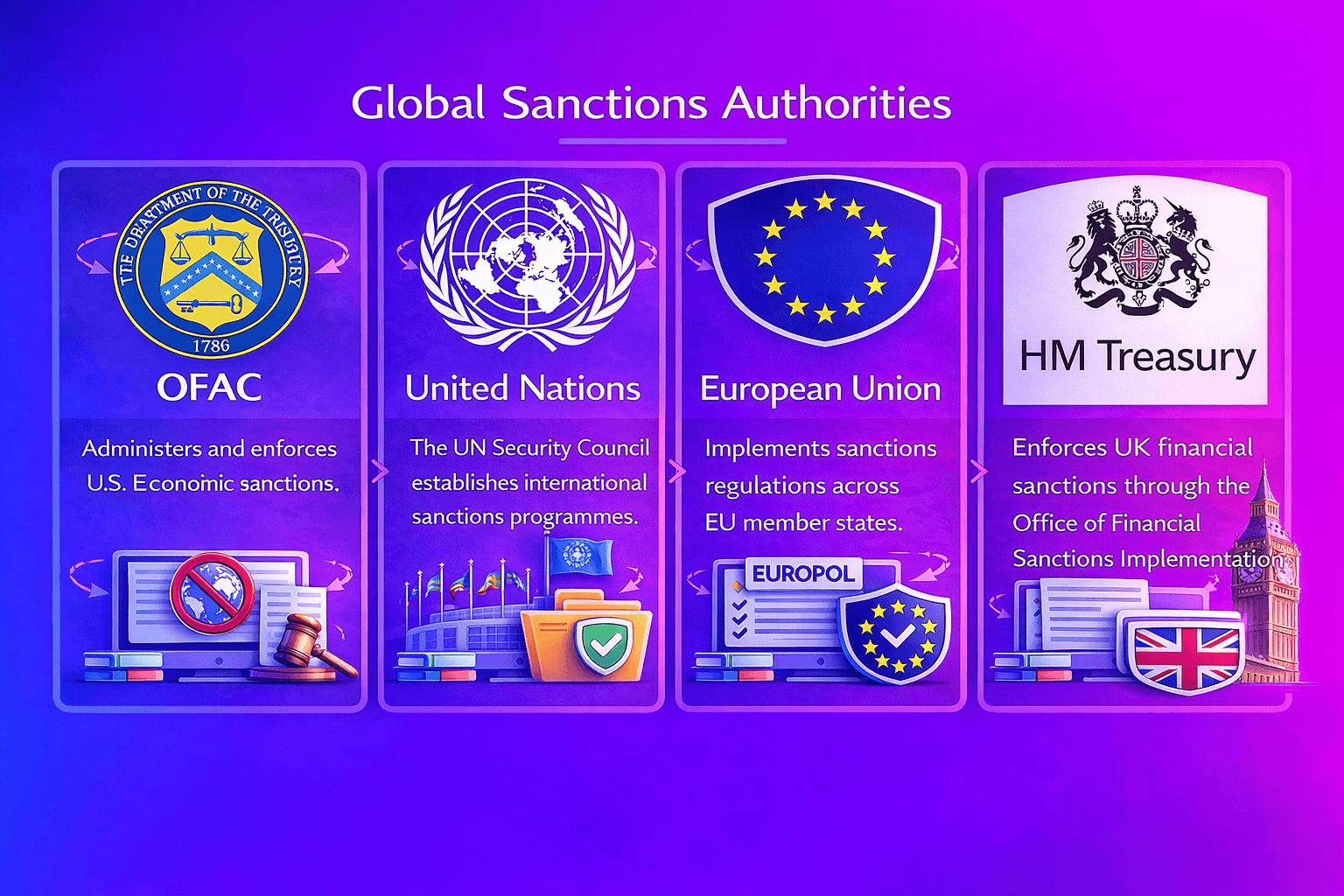
The United Nations Security Council
The United Nations Security Council is one of the most important sources of global sanctions programmes. UN sanctions are issued through Security Council resolutions and are typically implemented by member states through national legislation.
These sanctions programmes often target terrorism financing networks, weapons proliferation activities, and individuals connected to geopolitical conflicts. Because UN member states are expected to enforce these resolutions, UN sanctions frequently form the foundation for national sanctions frameworks.
Information about these programmes is published through the United Nations Security Council sanctions regimes portal, which provides details about sanctions committees and designated individuals.
United States Sanctions Authority
The United States operates one of the most influential sanctions programmes in the world. Sanctions enforcement is administered by the Office of Foreign Assets Control (OFAC), which operates within the US Department of the Treasury.
OFAC maintains extensive sanctions lists that include individuals, organisations, vessels, and aircraft associated with sanctioned activities. Because the US dollar plays a central role in global finance, OFAC sanctions often affect financial institutions worldwide.
Guidance and programme information are published through the Office of Foreign Assets Control sanctions programmes portal, which outlines the different sanctions regimes administered by the United States.
United Kingdom Sanctions Authority
The United Kingdom administers sanctions programmes through the Office of Financial Sanctions Implementation (OFSI), which operates within HM Treasury.
OFSI maintains the UK Consolidated List of financial sanctions targets and provides guidance to financial institutions regarding sanctions compliance obligations. UK sanctions programmes may implement UN sanctions, mirror sanctions introduced by allied governments, or introduce independent sanctions measures.
Details about enforcement expectations and reporting obligations can be found within UK financial sanctions guidance published by OFSI.
How Sanctions Lists Are Used In Compliance Systems
Financial institutions must incorporate sanctions lists from multiple authorities into their screening controls. This ensures that customers and transactions are evaluated against relevant regulatory requirements.
Customer Screening
When a new customer relationship is established, institutions compare the customer's identity information against sanctions lists using systems such as modern customer screening platforms. These systems evaluate names, aliases, and other identifiers to detect potential matches.
Payment Screening
Transactions must also be evaluated against sanctions lists before they are processed. Screening engines analyse payment data to ensure that sanctioned parties are not involved in financial activity.
Alert Investigation
When a screening system identifies a potential match, investigators review the alert and determine whether the match represents a true sanctions exposure. Structured alert adjudication workflows help investigators document their analysis and maintain consistent decision making.
Operational Challenges In Global Sanctions Screening
Managing sanctions compliance across multiple authorities introduces several operational challenges.
Frequent List Updates
Sanctions lists change frequently as authorities add or remove designations. Compliance systems must therefore update sanctions data continuously.
Name Variations
Sanctioned individuals may appear under multiple name spellings or aliases, requiring sophisticated matching logic.
Jurisdictional Differences
Different sanctions authorities apply designations differently, which can create complexity for institutions operating globally.
False Positive Alerts
Name similarities between sanctioned individuals and legitimate customers can generate alerts that investigators must review.
Addressing these challenges requires strong data governance and reliable screening systems.
What Effective Sanctions Compliance Looks Like
Financial institutions that manage sanctions screening effectively typically demonstrate several key characteristics.
Reliable Watchlist Data
Sanctions lists are consolidated and maintained accurately across compliance systems.
Consistent Investigation Procedures
Compliance teams follow structured investigation workflows when reviewing screening alerts.
Continuous Monitoring
Institutions monitor sanctions programme updates and adjust their screening controls accordingly.
Strong Governance
Sanctions compliance responsibilities are clearly defined within the organisation.
These practices help institutions maintain confidence that their sanctions controls operate effectively.
Professional Insight And Operational Confidence
Sanctions authorities operate within a complex global regulatory environment where geopolitical developments can rapidly influence compliance obligations. Financial institutions must therefore maintain flexible systems capable of adapting to new sanctions programmes and regulatory expectations.
Organisations that maintain reliable sanctions data, efficient screening systems, and well trained investigators are better positioned to manage these challenges while maintaining confidence in their compliance frameworks.
Practical Experience
Compliance professionals often observe that sanctions screening effectiveness improves significantly when sanctions lists are maintained through structured data management processes.
Technical And Regulatory Expertise
Understanding the structure of global sanctions authorities helps compliance teams design screening controls that align with international regulatory expectations.
Building Confidence In Controls
When screening systems operate consistently across multiple sanctions lists, institutions can demonstrate that their compliance frameworks remain robust and defensible.
People First Compliance Content
Sanctions compliance ultimately depends on investigators who review screening alerts and determine whether potential matches represent genuine regulatory risks. Technology enables rapid screening of customers and transactions, but human expertise remains essential for interpreting results and documenting investigation decisions.
Educational resources like this help compliance professionals understand how sanctions authorities operate and how their programmes influence financial crime controls within regulated institutions.
Next Steps For Your Organisation
As sanctions programmes continue to evolve in response to geopolitical developments, financial institutions must ensure that their screening systems remain aligned with current regulatory expectations.
If your organisation is reviewing its sanctions screening controls, explore how your compliance framework compares with current industry practices.